

Industrial Evaporative Air Cooler vs Traditional AC: Which Works Better in Bangladesh?

If you run a factory floor, a warehouse, or any large workspace in Bangladesh, you already know that cooling isn’t optional, it’s part of keeping people working and products safe. But when it’s time to actually buy, most suppliers will only push one system: theirs..
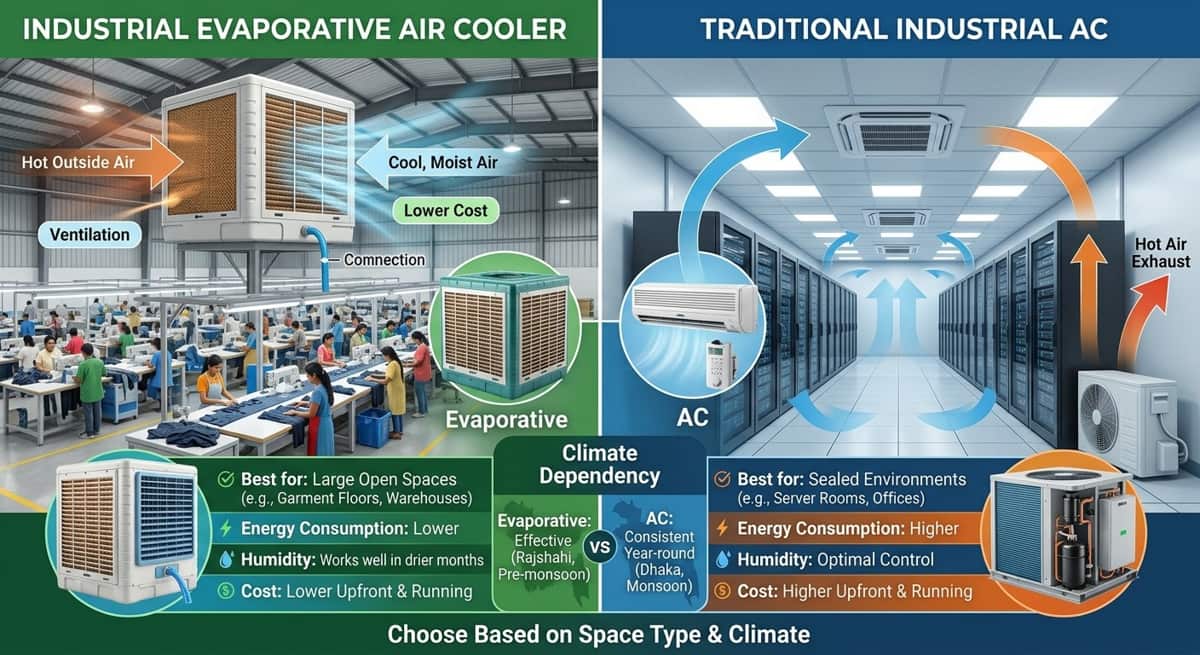
If your space is large, open, and well-ventilated a garment floor, a warehouse, a poultry shed and an industrial evaporative air cooler will usually cool it faster and far more cheaply, especially outside the monsoon months. If your space is sealed, humid-sensitive, or needs a precise, steady temperature a server room, a cold store, an office, a showroom, traditional AC is the safer, more reliable choice. Many larger facilities in Bangladesh actually use both, in different zones.
Why This Decision Matters Right Now
Cooling isn’t a small line item anymore. Electricity costs have climbed, and load-shedding still hits industrial zones outside Dhaka hard enough to shut down production for hours at a time. If your cooling system draws heavily on the grid, every outage becomes a bigger problem than it needs to be.
At the same time, industrial space is expanding fast; new RMG (garment) units, cold-chain warehouses, and agro-processing plants are opening across districts well beyond Dhaka and Chattogram. A wrong cooling decision made now doesn’t just cost money upfront; it follows you every month on the electricity bill, and it shows up in worker comfort, product quality, and machine lifespan for years. This is worth getting right the first time.
How an Industrial Evaporative Air Cooler Works
An evaporative cooler works on a simple idea: pull in hot outside air, pass it over water-soaked pads, and push out air that’s noticeably cooler and fresher with no chemicals, no sealed refrigerant loop, just water and airflow. Because the air keeps moving and gets replaced constantly, spaces stay ventilated rather than recirculating the same stale air all day.
This is why you’ll already see evaporative cooling used across garment factories, poultry farms, and warehouses in Bangladesh spaces with high ceilings, open floors, and machines or workers generating a lot of heat. You may also hear these called “desert coolers” or “air washers” , the same basic technology, different names depending on the supplier.
How Traditional AC Works
Traditional AC cools air through a sealed refrigerant cycle it doesn’t bring in outside air, it cools and recirculates the air already inside the room. For industrial buyers in Bangladesh, exploring the different types of air conditioning systems is essential. Common options include split units for smaller rooms, cassette units for offices, and ducted or VRF systems for larger, multi-zone facilities.
The key difference to keep in mind through the rest of this guide: AC seals and controls air in a closed space, while evaporative cooling moves and refreshes open air. That one distinction decides almost everything else cost, performance, and which spaces each system actually suits.
Bangladesh’s Climate Is the Real Deciding Factor
Evaporative cooling’s performance depends heavily on humidity, and Bangladesh’s climate isn’t the same all year.
- Winter (November–February): Dry and mild. Evaporative coolers perform very well here, often bringing indoor temperatures down noticeably.
- Pre-monsoon (March–May): Hot and still fairly dry in most regions this is where evaporative cooling does its best work, especially in northern and western districts like Rajshahi and Rangpur.
- Monsoon (June–September): High humidity, especially in coastal and southern areas. Evaporative cooling loses much of its effect here because the air is already saturated with moisture it simply can’t absorb much more.
If your facility is in a drier inland zone and runs seasonal or year-round operations where a slightly warmer, humid monsoon stretch is manageable, evaporative cooling makes strong financial sense. If you’re in a humid coastal belt, or you need consistent year-round performance no matter the season, that’s where AC or a hybrid setup earns its cost.
Head-to-Head Comparison
Upfront Cost & Installation
Evaporative coolers are generally cheaper to buy and simpler to install with no ductwork or refrigerant lines required, often just a water connection and power point. Industrial AC systems, especially ducted or VRF setups, cost significantly more upfront. Partnering with reliable industrial air conditioner providers ensures proper installation and long-term servicing contracts.
Running Cost & Electricity Consumption
This is where evaporative cooling really stands out. It typically uses a fraction of the electricity that AC does, because it’s only running a fan and a water pump, not a compressor. In a country where load-shedding and rising tariffs are a real operating cost, this difference adds up fast across a large floor running long shifts.
Cooling Performance by Space Type
In large, open, ventilated spaces, evaporative coolers can outperform AC simply because AC struggles to cool a space that isn’t sealed; the cool air escapes as fast as it’s produced. In small, closed rooms, AC will always cool more precisely and consistently, which is exactly what sealed environments need.
Maintenance & Water Requirements
Evaporative coolers need a steady, reasonably clean water supply and regular cleaning or replacement of evaporative cooling pads to avoid mineral buildup worth checking if your site has reliable water access. AC systems need refrigerant checks, filter cleaning, and occasional professional servicing, which usually costs more per visit but happens less often.
Air Quality & Worker Health Considerations
Evaporative cooling constantly brings in fresh outside air, which many factory floors prefer for ventilation. AC recirculates indoor air, which needs clean filters to avoid dust and staleness building up in enclosed spaces. Neither is automatically “healthier” it depends on how well the system is maintained and how enclosed your space is.
Which One Should You Choose? A Quick Guide by Business Type
Garment/textile factories: Evaporative cooling is usually the better fit for large open floors, high heat from machines and lighting, and a strong need to control electricity costs across long shifts.
Warehouses & cold storage (non-refrigerated general storage): Evaporative works well for general warehousing; but if you’re storing anything temperature-sensitive, AC or dedicated refrigeration is the safer call.
Food processing units: AC is generally required here, since temperature consistency and air control matter for hygiene and product safety.
Offices, showrooms, and reception areas: AC is the practical choice; these are sealed spaces where people expect a steady, controlled temperature.
Poultry farms & agro-processing: Evaporative cooling is widely used and cost-effective here, particularly for open-sided sheds with good airflow.
Can You Use Both? Hybrid Cooling Setups
Many larger Bangladeshi facilities don’t choose one system; they zone it. The main production floor runs on evaporative cooling to keep electricity costs down across a large open area, while smaller enclosed spaces quality control labs, server rooms, management offices run on AC where precise, sealed cooling actually matters. If your facility has a mix of open and closed areas, this is often the most practical answer, not a compromise.
What It Typically Costs in Bangladesh
| System Type | Typical Upfront Cost (Industrial Scale) | Estimated Monthly Running Cost |
| Evaporative Air Cooler | Lower often a fraction of comparable AC capacity | Low mainly fan, pump, and water |
| Split/Cassette AC | Moderate to high, per unit | Moderate to high, depending on hours run |
| Ducted/VRF AC System | High includes ductwork and installation | High, especially during peak summer months |
These figures vary a lot by brand, capacity, and vendor, so treat this as a starting point for comparison rather than a fixed quote get on-site assessments before finalizing a budget.
Common Mistakes to Avoid
A few mistakes come up again and again when businesses choose industrial cooling in Bangladesh:
- Undersizing the unit to save money upfront, then finding it can’t cool the actual floor area
- Ignoring the local humidity pattern and installing evaporative cooling in a coastal, high-humidity zone expecting AC-level performance
- Skipping workplace ventilation planning, evaporative cooling needs proper airflow via mounted exhaust fans for warm, moist air to escape, or it won’t work properly.
- Choosing purely on price without factoring in the running cost difference over a full year, especially during peak summer
Avoiding these upfront saves far more than the small amount you might save by cutting corners at purchase.
Which Cooling System Is Right for Your Facility in Bangladesh?
There’s no single winner here; the right choice depends on how your space is built, which part of Bangladesh you’re operating in, and what you’re cooling for. Evaporative cooling wins on cost and performance in large, open, drier-zone spaces. AC wins where you need sealed, consistent, year-round control. If you’re not sure which side of that line your facility falls on, it’s worth getting an on-site assessment before committing the humidity, floor layout, and ventilation of your specific space will usually make the answer obvious.
FAQs
Is evaporative cooling effective in Dhaka’s climate?
It works well during Dhaka’s drier months but loses effectiveness during the humid monsoon season. Many Dhaka-based facilities pair it with AC in enclosed zones for year-round reliability.
How much electricity does an industrial evaporative cooler save compared to AC?
It varies by unit and usage, but evaporative coolers generally use significantly less power than AC, since they don’t run a compressor, a meaningful saving on long shifts.
Can evaporative coolers work in a closed factory space?
Not well. They depend on constant airflow and a way for warm, moist air to exit. In fully sealed spaces, they can actually raise humidity without cooling effectively.
What’s the maintenance cost difference over a year?
Evaporative coolers need more frequent, lower-cost upkeep mainly pad and water system cleaning. AC needs less frequent but higher-cost servicing, including refrigerant checks.
Which is better for RMG (garment) factories specifically?
Evaporative cooling is widely used across garment floors because of the large open layout and the strong incentive to keep electricity costs down.