

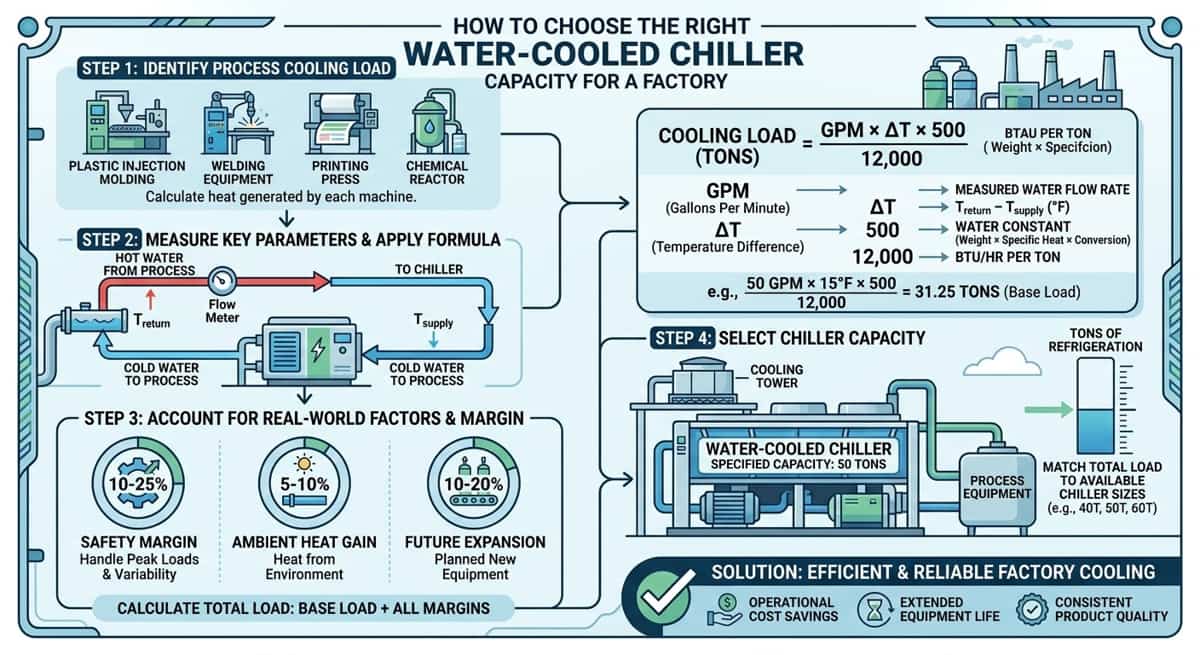
How to Choose the Right Water-Cooled Chiller Capacity for a Factory

Buying a chiller for your factory is not something you want to get wrong. Too small, and it will run non-stop trying to keep up, wearing itself out and still leaving your production line too warm. Too big, and you’re paying for cooling power you never actually use every single month, on every single electricity bill.
Getting the size right the first time saves you money, protects your production, and saves you the headache of replacing an expensive machine far sooner than you should have to.
Why Getting Chiller Capacity Wrong Costs Bangladeshi Factories
Walk into almost any textile dyeing unit or plastics factory in Gazipur, Narayanganj, or Chattogram during peak summer, and you’ll hear the same complaint: the chiller just can’t keep up. In most cases, it’s not that the machine is faulty, it’s that it was undersized from day one. An undersized chiller has to run constantly, with the compressor barely getting a break. In Bangladesh’s heat and humidity, that means the unit works even harder than it would in a cooler climate, wearing out compressors and components years before they should fail. Production slows down, product quality suffers especially in dyeing, food processing, and pharma, where temperature control isn’t optional and repair costs start piling up.
On the other hand, an oversized chiller isn’t a “safe” choice either. It cycles on and off more than it should, uses more electricity than the job requires, and in a country where industrial power costs are a real line item on every factory’s budget, that adds up fast. The right size isn’t about buying the biggest unit you can afford, it’s about matching the machine to your actual production needs.
Learn more about How Water-Cooled Chillers Operate in Bangladesh’s Industrial Facilities and whether it could be the right solution for your production requirements.
What “Chiller Capacity” Actually Means (Tons of Refrigeration, Explained Simply)
When suppliers talk about chiller size, they usually talk in “tons” more specifically, Tons of Refrigeration, or TR. This can be confusing because it has nothing to do with the physical weight of the machine. One ton of refrigeration is simply a unit of cooling power, a way of measuring how much heat a chiller can remove from your process in an hour.
You’ll also hear cooling capacity described in kW (kilowatts) or BTU/hr (British Thermal Units per hour), especially on imported equipment spec sheets. These are just different ways of measuring the same thing, and they convert easily between each other. What matters for you as a buyer isn’t memorizing the conversion, it’s understanding that this number represents how much heat your chiller can pull out of your process, water, or space in a given amount of time. Everything else in this guide is really about figuring out what that number needs to be for your factory.
The Core Factors That Determine Your Required Chiller Size
There’s no single “right size” that applies to every factory; it depends on a handful of real, measurable factors specific to your operation.
Heat Load From Your Production Process
This is the biggest factor by far. A plastic injection molding machine generates a very different heat load than a textile dyeing vat or a food processing tank. You need to know how much heat your actual equipment or process produces. This usually comes from your machine’s technical specifications or from measuring the temperature rise in your process water. The chiller’s job is to remove exactly this amount of heat, so getting this number right is the foundation of everything else.
Ambient Temperature and Humidity in Bangladesh
A chiller doesn’t operate in a vacuum; it has to reject heat into the surrounding air, and Bangladesh’s climate makes that harder than it would be in a cooler country. Summer temperatures regularly cross 35°C with high humidity, which means the chiller has to work harder to dump heat outside than the same machine would in a milder climate. Any capacity calculation that doesn’t account for local peak summer conditions will leave you short exactly when you need cooling the most.
Water Flow Rate and Temperature Differential (ΔT)
Your chiller’s capacity is directly tied to how much water is flowing through the system and how many degrees that water needs to drop. A higher flow rate with a smaller temperature drop needs different sizing than a lower flow rate with a bigger drop. Your supplier should walk through this with you rather than skip straight to a number; it’s a core part of matching capacity to your process.
Room/Building Insulation and Layout
If your factory floor is poorly insulated, sits under a tin roof with no shading, or has chilled water pipes running long distances without insulation, you lose cooling along the way. That lost cooling has to be made up somewhere which means your chiller needs extra capacity just to compensate for heat gain that never should have happened in the first place. Good insulation and thoughtful pipe layout can genuinely reduce the size of the chiller you need to buy.
A Simple Way to Estimate Your Cooling Load
You don’t need an engineering degree to get a workable estimate. Here’s a simplified way to think through it.
Start with the heat generated by your process, in kilowatts. Let’s say you run a plastic injection molding operation, and your machines generate roughly 40 kW of heat that needs to be removed during production. To get a rough chiller size in tons of refrigeration, you divide this heat load by roughly 3.5 (since 1 TR is approximately equal to 3.5 kW of cooling). In this example: 40 kW ÷ 3.5 ≈ 11.4 TR.
From there, you’d add a safety margin typically 10 to 20% to account for peak summer ambient conditions, future wear on the system, and any inefficiencies in insulation or piping. That pushes our example factory to roughly 13 to 14 TR as a realistic working target.
This is a starting estimate, not a final number your supplier or a cooling engineer should still confirm it against your specific machines and site conditions. But walking into that conversation with your own rough number means you can sanity-check whatever figure they come back with, instead of taking it purely on faith.
Typical Chiller Capacity by Industry What Bangladeshi Factories Actually Use
Every factory is different, but knowing what similar operations typically use gives you a useful reference point.
Textile dyeing and finishing units tend to need larger industrial chiller solutions, often in the range of 50 TR to well over 200 TR for bigger mills, because dyeing processes involve continuous, high-volume heat removal across multiple vats running at once. .
Plastic injection molding factories usually fall in a more moderate range, often somewhere between 10 TR and 60 TR, depending on the number and size of molding machines running simultaneously.
Pharmaceutical cold storage and production tends to prioritize precision and consistency over sheer size, with capacity requirements varying widely based on storage volume and the strictness of temperature tolerance required for the products involved.
Food and beverage processing plants typically need mid-range capacity, often 20 TR to 100 TR, depending on whether the chiller is supporting product cooling, process water, or both.
Electronics assembly facilities generally need smaller, more precise cooling often under 20 TR but with tighter temperature control requirements than heavier industrial processes.
These are reference ranges, not prescriptions. Your actual number should come from your own heat load calculation, not from copying what a similar-sounding factory down the road is using.
Common Sizing Mistakes Bangladeshi Factories Make
A few mistakes show up again and again when factories choose chiller capacity:
- Undersizing to save on upfront cost. A cheaper, smaller chiller looks better on the initial invoice, but it usually costs more over time through higher energy use per unit of cooling, faster wear, and lost production during breakdowns.
- Ignoring peak summer ambient loads. Sizing a chiller based on a mild day in January means it will fall short exactly when demand is highest, in the middle of summer.
- Not planning for future production expansion. If you’re planning to add another production line in the next two or three years, sizing only for today’s needs means you’ll be replacing the chiller sooner than necessary.
- Copying a competitor’s chiller size without matching process conditions. Two factories in the same industry can have very different heat loads based on their specific machines, layout, and insulation. A number that works for someone else may not work for you.
Water-Cooled vs. Air-Cooled Which Makes More Sense for Your Factory?
Water-Cooled and Air-Cooled chiller systems both types of chillers do the same basic job removing heat from your process but they reject that heat differently, and the right choice depends on your specific situation.
Industrial water-cooled chillers systems are generally more energy-efficient, especially at larger capacities, because water absorbs and transfers heat more effectively than air. For factories running continuous, high-load processes like textile dyeing or large-scale plastic production this efficiency advantage can translate into meaningful electricity savings over the life of the machine. The trade-off is that water-cooled systems need a reliable water source and typically require a cooling tower, which adds to the footprint and maintenance needs of the system.
Industrial air-cooled chillers systems are simpler to install, don’t depend on a consistent water supply, and tend to suit smaller operations or facilities where water access is limited or costly. They’re often the more practical choice for smaller factories or standalone production units where the efficiency gains of a water-cooled system wouldn’t offset the added infrastructure.
If your factory runs large, continuous cooling loads and has reliable access to water, a water-cooled system is usually the better long-term investment. If your operation is smaller or water access is a constraint, air-cooled may be the more sensible starting point.
How to Choose a Reliable Chiller Supplier in Bangladesh
Sizing the chiller correctly is only half the job; the other half is making sure you’re buying a genuine, properly supported machine. This is where many factories run into trouble later, even after getting the capacity calculation right.
When choosing a supplier, ask directly whether the unit is sourced from an authorized distributor of the brand rather than through the grey market. Grey-market units may come without valid warranties, and getting genuine spare parts or qualified service later can become a serious headache.
With a reliable supplier like Seraphic, after-sales support should also be an important part of your decision. Ask whether the supplier has local technicians who can service the unit or whether you’ll be waiting for parts or specialists from abroad whenever something goes wrong. Confirm warranty terms in writing, not just verbally, and ask whether commissioning support is included meaning the supplier will be present to properly install, test, and start up the system rather than simply delivering the equipment.
A slightly higher price from a trusted supplier such as Seraphic, offering genuine parts, local service, and proper commissioning support, is almost always a better investment than choosing a cheaper unit that could leave your factory stranded during its first major breakdown.
Maintenance Habits That Protect Your Chiller’s Effective Capacity Over Time
A chiller that’s sized perfectly on day one can still underperform two years later if it isn’t maintained properly. Water treatment matters more than most factories realize untreated water leads to scaling and buildup inside the system, which reduces heat transfer efficiency over time, effectively shrinking your chiller’s real-world capacity even though nothing on the spec sheet has changed. Regular condenser cleaning keeps the system able to reject heat as designed, and periodic refrigerant checks catch slow leaks before they turn into major performance drops or compressor damage.
Think of maintenance as protecting the sizing decision you already made. A well-maintained chiller keeps delivering the capacity you calculated, while a neglected one slowly falls short of it.
Get the Sizing Right Before You Get the Quote
The chiller you buy is going to run for years, so it’s worth taking the time to understand your actual cooling needs before a supplier hands you a number. Calculate your heat load, account for Bangladesh’s climate, think ahead to future expansion, and choose a supplier who stands behind the equipment after it’s installed. Once you have a realistic capacity range in hand, reach out to Seraphic BD’s cooling specialists to receive a tailored technical quote that fits your exact factory requirements.
Frequently Asked Questions
How many tons of chiller do I need per 1,000 sq ft of factory space?
There’s no fixed ratio, because capacity depends on what’s happening inside that space a 1,000 sq ft dyeing area needs far more cooling than the same space used for light assembly. Always size based on process heat load, not floor area alone.
Can one chiller serve multiple production lines?
Yes, as long as the combined heat load of all the lines is calculated together and the chiller is sized and piped to handle simultaneous demand from each one.
How much electricity does a water-cooled chiller use in Bangladesh?
It varies by size and efficiency, but water-cooled systems generally use less electricity per ton of cooling than air-cooled systems of the same capacity, which matters given local power costs.
What’s the lifespan of an industrial water-cooled chiller?
A properly sized and well-maintained water-cooled chiller typically lasts 15 to 20 years, though correct sizing and consistent maintenance are what get you to the higher end of that range.