

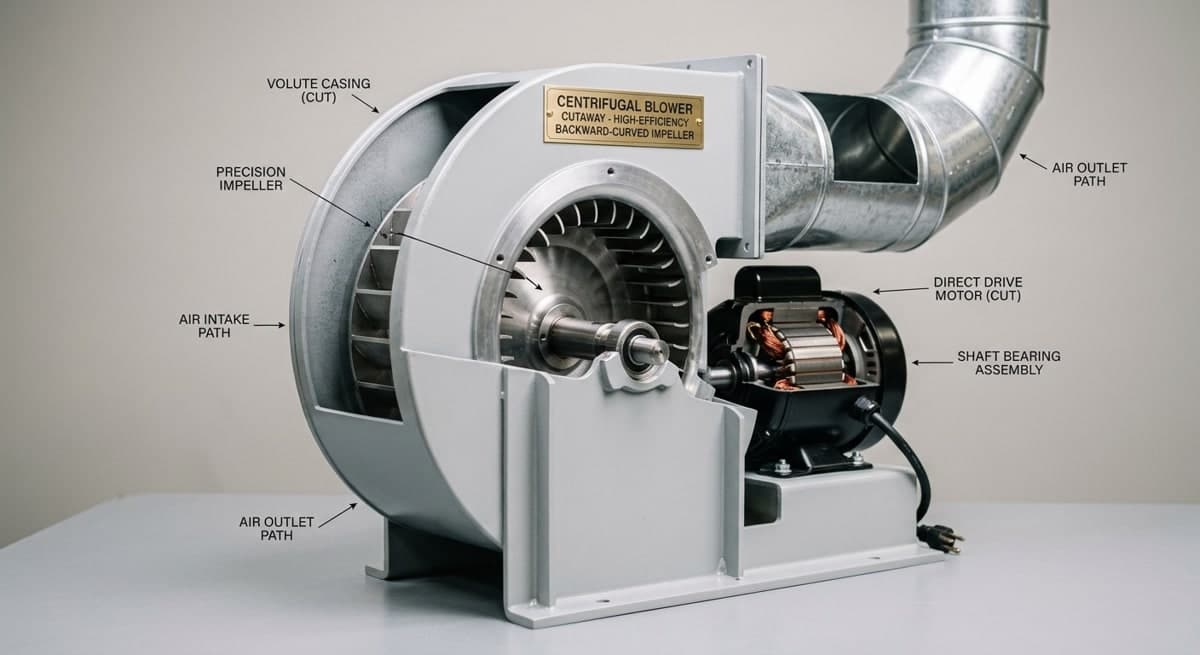
How to Choose the Right Industrial Centrifugal Blower Fan for Your Factory

Picking the wrong blower is an expensive mistake. If it is too small, your dust extraction or exhaust never works properly. If it is too big, you pay for power you don’t need, every single month.
The good news is that the choice comes down to four things: how much air you need to move, how much resistance that air will face, what kind of air it is (clean, dusty, hot or corrosive), and the conditions where the blower will run. Once you know these, you check them against the maker’s fan curve and you are most of the way there.
What a Centrifugal Blower Does
An industrial centrifugal blower fan pulls air in along its shaft, then throws it outward with a spinning impeller. The air turns 90 degrees and leaves at higher pressure. That pressure is the main difference from an axial fan, which pushes air straight through, much like a pedestal fan.
Here is how the two compare:
| Centrifugal blower | Axial fan | |
| Pressure | Handles high resistance | Best for low resistance |
| Ducts and filters | Works well with long ducts, bends and filters | Loses airflow quickly as resistance rises |
| Dusty or dirty air | Some designs handle heavy dust | Usually suited to fairly clean air |
| Size | Larger and heavier | Compact, fits in a wall or duct |
| Typical use | Dust collection, fume exhaust, boilers, dryers, conveying | Open-space ventilation, cooling |
A simple rule: if your air has to travel through ducts, filters, scrubbers or other obstacles, a centrifugal blower is usually the safer choice. If you are just moving a lot of air through an open wall or roof, a standard Industrial ventilation fan or roof-mounted exhaust fan is often enough.
Step 1: Define Airflow and Static Pressure
Start with the job the air must do. For general ventilation, multiply the room volume by the number of air changes per hour you need. For dust or fume extraction, multiply the opening area of each hood by the speed at which air must be drawn in to capture the dust.
a workshop measuring 20 m × 15 m × 5 m holds 1,500 m³. At 15 air changes per hour, you need 22,500 m³/h, or about 13,200 CFM.
Work out the static pressure
Static pressure is the resistance your blower must push against. Add up the loss in every part of the air path: industrial HVAC duct length, each bend, filters, dampers, hoods and any scrubber. Filters clog over time, so allow for that too.
This is where most sizing errors happen. If you underestimate pressure, the blower delivers far less air than promised, even when the airflow number on the nameplate looks correct.
Read the fan curve against your system curve
Every blower has a fan curve, a graph showing how much air it moves at each pressure level. Your ductwork has its own curve, showing how resistance rises as airflow rises. Where the two lines cross is the operating point. That is what the blower will really do in your factory.
Choose a blower whose operating point sits close to its most efficient range. This keeps power use, noise and wear lower. Ask your supplier to mark your operating point on the curve.
Step 2: Match the Impeller Type to Your Air Stream
The impeller is the heart of the blower, and its blade shape decides what kind of air it can handle. Here is a plain guide:
| Impeller type | Efficiency | Handles dust? | Pressure | Common use |
| Forward-curved | Lower | Poor | Low to medium | Clean air, small ventilation units |
| Backward-curved or inclined | Good | Moderate (light dust) | Medium to high | General factory ventilation, filtered dust systems |
| Airfoil | Highest | Clean air only | Medium to high | Large clean-air systems, boiler forced-draft air |
| Radial (paddle) | Lower | Very good | Medium to high | Abrasive or sticky dust, material conveying |
Clean air or dirty air? If the air is clean, a backward-curved or airfoil impeller saves the most energy. If it carries lint, husk, cement or ceramic dust, a sturdier radial design lasts longer, even though it uses more power. Putting a delicate, high-efficiency impeller in dusty air is a common reason blowers wear out early.
Worn blades are normal in abrasive jobs. If your dust is hard or gritty, ask for wear liners or replaceable blades so you can renew the worn parts instead of the whole impeller.
Step 3: Check Your Operating Environment
Heat and humidity
Bangladesh’s heat and monsoon humidity are hard on motors. Standard motors are commonly rated for ambient temperatures up to about 40°C, so tell your supplier if the blower sits near ovens, dryers or a boiler house. For damp or dusty areas, ask about the motor’s IP rating and insulation class. If you are near the coast or a river belt, salty air speeds up corrosion, so ask about coatings.
Dust, corrosive fumes and explosive atmospheres
Plain mild steel is fine for many jobs. For acid vapours, dyeing-house fumes or tannery and ETP exhaust, consider stainless steel, FRP or a protective coating. Hot gas also changes how a blower performs, so always give the real air temperature.
If you handle flammable dust, solvents or gases, a normal blower may not be safe. These areas need explosion-protected equipment, and the choice should be made with a qualified safety engineer, not from a catalogue alone.
Noise and space
A loud blower tires workers and can cause hearing damage over time. Ask for the sound level at a stated distance.Inlet or outlet silencers or an enclosed high-pressure centrifugal blower can help keep decibels down. Also check that you have room for the blower, its motor, access for maintenance and any ducting.
Step 4: Choose the Motor, Power Supply and Drive Type
Industrial supply in Bangladesh is typically 400 V, 50 Hz, three-phase, but confirm this at your site, because the motor must match. If your voltage often drops or swings, tell your supplier. Ask for a motor with a sensible power margin above what the fan needs, and look for an efficient motor (IE3 class), since the motor runs for thousands of hours.
Using a variable frequency drive (VFD)
A VFD lets you change the blower’s speed instead of closing a damper and wasting energy. It also gives a gentle start, which is kinder to belts, bearings and your supply. Fan power falls quickly as speed drops, so a VFD often pays off where demand changes through the day. The actual saving depends on how your system runs, so ask for a calculation based on your duty, not a general promise.
Direct drive or belt drive
In a direct-drive blower, the impeller sits on the motor shaft. There are fewer parts to maintain, but the speed is fixed unless you add a VFD. A belt drive lets you change speed by swapping pulleys and keeps the motor away from hot or dirty air, but belts need regular checking and replacing. Choose based on who will maintain it and how easy bearing access is.
Step 5: Verify Standards, Testing and Safety
Ask for a performance curve that was tested to a recognised method, such as AMCA 210 or ISO 5801. A catalogue curve with no test method behind it is a weak basis for a purchase. Also ask for the balancing grade on the report and a material certificate for the impeller and housing.
Check the safety basics before you sign:
- Guards on the inlet and on any exposed belt or shaft
- A vibration level you can monitor
- A place to fit an emergency stop
Rules on ventilation, boilers and fire safety come from Bangladeshi law and from buyer audits. Check the current requirements with your safety officer or a qualified consultant before you finalise the specification.
Which Blower Suits Your Industry?
Every factory moves air differently, which is why choosing from the right range of industrial air circulation blowers matters; a garment unit needs lint extraction, while a boiler house deals with hot gas.
Find your industry in the table below for a good starting point on impeller, material and what to watch out for.
| Industry | Typical use | Suggested impeller | Material | Watch out for |
| Garments and textiles | Lint and dust extraction, dyeing-house exhaust | Radial for lint-heavy air, backward-curved after filters | Coated mild steel; stainless for acid vapour | Lint blocking filters, so plan regular cleaning |
| Boilers | Forced-draft (clean air) and induced-draft (hot flue gas) fans | Backward-curved or airfoil for forced draft; sturdy radial for induced draft | Mild steel; heat-resistant build for hot gas | Gas temperature and bearing cooling; check with the boiler maker |
| Tanneries and ETP | Fume and odour exhaust | Backward-curved or radial | FRP or coated stainless steel | Corrosion, so state which chemicals are present |
| Ceramics and cement | Dryer, kiln and dust fans | Radial with wear liners | Steel with replaceable wear plates | Abrasion and heat |
| Food and rice mills | Drying air, husk and grain conveying | Backward-curved for drying air; radial for conveying | Mild steel or stainless for food areas | Fine dust can be a fire or explosion risk, so get safety advice |
| Pharma | Clean air supply | Airfoil or backward-curved | Stainless or powder-coated | Low noise, low vibration and clean-room rules; confirm with your HVAC designer |
Importing vs Local Purchase: Think About Total Cost
The cheapest blower on the quotation is rarely the cheapest to own. Over its life, you pay for electricity, maintenance, spare parts and any downtime when it stops. Electricity is often the biggest part.
A blower drawing 30 kW for 6,000 hours a year uses 180,000 kWh. Multiply that by your tariff to see the yearly cost. If a better model uses just 3 kW less, that saves 18,000 kWh every year, and the extra price can pay back over time.
Import checklist
Before you order an imported blower, confirm:
- The production and delivery lead time
- Payment terms, such as LC or TT
- Shipping, customs clearance and who handles them
- Who will install and commission it
- Which spare parts you should keep in stock locally
Warranty and after-sales support
A blower is only as good as the support behind it. Ask who will visit if it fails, how fast they respond and whether bearings, belts and impellers are available locally.
Common Mistakes Bangladeshi Buyers Make
- Oversizing “to be safe.” A blower that is too big wastes power and can run noisily or unstably.
- Ignoring duct resistance. The blower looks right on paper but underperforms once it is connected.
- Choosing on price alone. A low price often hides a weaker motor, a lower-grade impeller or no test report.
- Skipping the tested curve. Without it, you are trusting a number you cannot check.
- Forgetting spares. A missing belt or bearing can stop a line for days.
- Mismatching voltage. A motor built for a different supply leads to delays and extra cost.
What to Send With Your Quote Request
The more you share, the more accurate your quote. Please include:
- Required airflow and static pressure (or your best estimate)
- Air temperature and what is in the air (dust, lint, fumes, moisture)
- Site conditions, such as indoor or outdoor and any coastal exposure
- Voltage, phase and frequency
- Hours of use per day
- Drawings or photos of the duct layout and the space
Not sure about a number? Send what you have and request a custom blower price from our engineering team. We will help you work out the rest.
Conclusion
Choosing the right blower is simpler than it looks. Work out your airflow and pressure. Match the impeller to your air. Check the heat, dust and fumes where it will run.
Pick the right motor and drive. Then verify the tests and safety. If you would like a second pair of eyes, contact Seraphic Associate for a free sizing review.
Frequently Asked Questions
Which is better for a factory, a centrifugal blower or an axial fan?
It depends on resistance. Choose a centrifugal blower when air passes through ducts, filters or scrubbers. Choose an axial fan for open, low-resistance ventilation.
How do I work out the blower size I need?
Find your airflow and your total static pressure, then match both on the maker’s fan curve. Send us your layout and we can check it with you.
Is a VFD worth it for a blower?
Usually yes if your demand changes during the day. If the blower runs at full load all day, the benefit is smaller.
How long does a centrifugal blower last?
It depends on the duty, the dust level and maintenance. Bearings and belts usually need attention first. Regular checks extend the life of the whole unit.
Can I get a custom-built blower in Bangladesh?
Custom sizes and materials are possible through local fabrication or made-to-order import. Either way, ask for a tested performance curve.