

How to Calculate Required CFM for Your Factory’s Industrial Air Cooler

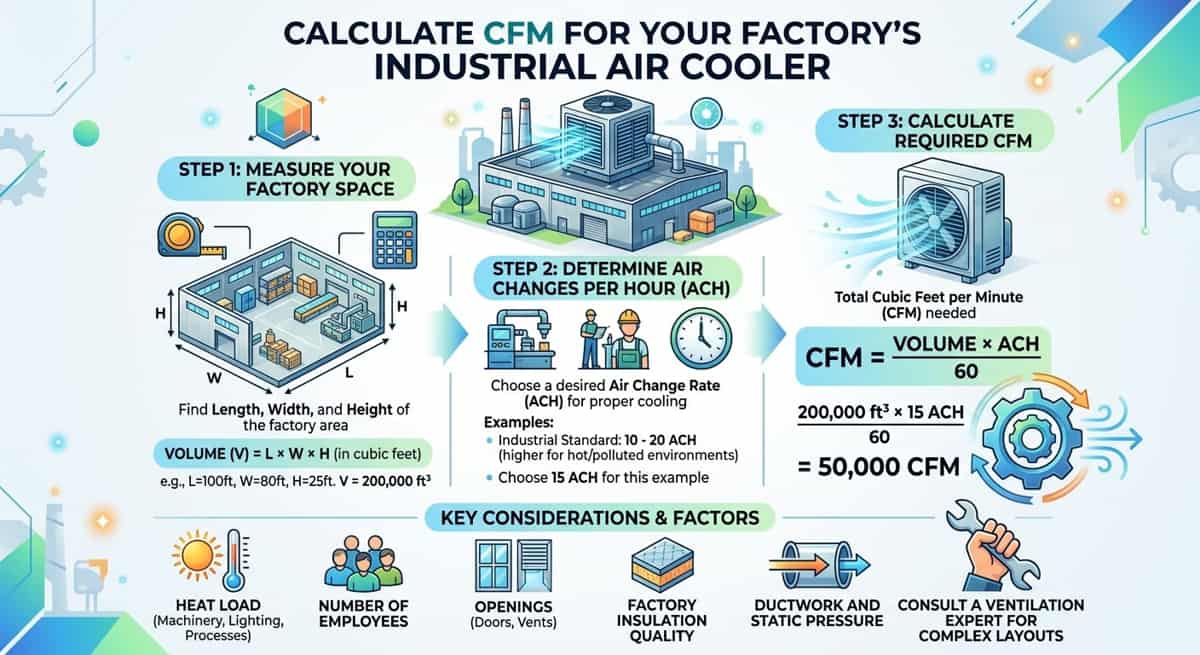
To find the exact airflow your factory needs, multiply your room’s total cubic volume by the required Air Changes Per Hour (ACH), and divide that number by 60 minutes.
Getting this calculation right is one of the most important decisions you will make for your facility. In Bangladesh, guessing your cooling capacity carries heavy risks. If you undersize your system, indoor heat builds up quickly. This leads to worker exhaustion, summer fainting incidents on the production floor, and failed compliance audits from RSC (formerly Accord), Nirapon, or international buyers. On the other hand, buying oversized machines wastes lakhs of Taka upfront and drives up your monthly REB or DESCO electricity bills.
What is CFM and Why Standard Textbook Formulas Fail in Bangladesh’s Climate
CFM (Cubic Feet per Minute) measures the volume of air an industrial evaporative cooler system delivers every sixty seconds. One CFM equals one cubic foot of fresh, cooled air moving into your workspace every minute. When you buy an industrial air cooler, you are really paying for the volume of air it can push across your floor.
However, relying on standard textbook calculations or overseas supplier catalogs often leads to disappointing results in Bangladesh. Most Chinese, European, or Western product catalogs calculate coverage areas assuming dry, arid climates with only 30% relative humidity. Bangladesh has a very different climate. Between April and October, our industrial zones experience high outdoor temperatures alongside 70% to 85% relative humidity.
Industrial air coolers work by passing warm air through wet honeycomb pads. As the water evaporates, it absorbs heat and cools the air. When outdoor humidity is already high, the air cannot absorb water as quickly, which lowers the temperature drop you get from evaporation alone. To keep workers cool in humid Bangladeshi weather, you cannot rely only on lowering the room temperature. You must increase the Air Changes Per Hour (ACH) to create a steady, fast-moving breeze across the floor. This continuous airflow speeds up sweat evaporation on the skin and pushes trapped factory heat out of the building before it settles.
The 4-Step Formula to Calculate Industrial Air Cooler CFM
Sizing your cooling system does not require complicated math. Follow these four steps to find the exact airflow capacity your production floor requires.
Step 1: Calculate Your Factory’s Total Cubic Volume (ft3)
Start by measuring the interior dimensions of your work area in feet:
Volume=Length*Width*Height
If your factory has a flat RCC concrete ceiling, simply measure from the floor to the slab. If you operate under a sloped corrugated tin-shed roof which is very common in Gazipur and Narayanganj measure the height at the side walls and the height at the center peak, then use the average of the two numbers.
Pro-Tip for High Ceilings: If your warehouse or shed roof is 25 feet high, you do not need to cool the empty space near the ceiling. For spot-cooling or worker-level ducting, use an “occupied cooling zone” height of 10 to 12 feet from the floor to avoid paying for wasted airflow.
Step 2: Determine the Right Air Changes Per Hour (ACH) for Bangladeshi Industries
Air Changes Per Hour (ACH) indicates how many times the entire volume of air inside your factory is replaced with fresh outdoor air every sixty minutes. A quiet storage room needs very few air changes, while a crowded garment floor with steam irons needs rapid air replacement to stay comfortable.
Use the table below to select the right ACH for your specific industry in Bangladesh:
| Industrial Sector / Floor Type | Recommended ACH | Why This Rate Is Needed |
| Garments (RMG) Sewing Floor | 25 – 35 ACH | High worker density and continuous sewing motor heat |
| RMG Finishing & Steam Ironing Section | 45 – 60 ACH | Heavy steam emissions and intense radiant heat |
| Textile Spinning, Knitting & Dyeing | 40 – 55 ACH | Continuous heavy machinery heat and fiber dust control |
| Plastic Injection Molding & Packaging | 45 – 60 ACH | Extreme heat radiated from melting barrels and molds |
| Pharmaceuticals / FMCG Warehouse (Storage) | 15 – 20 ACH | Low occupancy; prevents stagnant air and moisture buildup |
Step 3: Apply the Bangladesh Heat-Load & Humidity Correction Factor
Standard formulas assume an empty room with insulated walls. Real Bangladeshi factories deal with harsh external and internal heat sources that warm up the cool air as soon as it enters the building. To prevent your system from falling short during peak May or August heatwaves, multiply your required airflow by a local correction factor between 1.15 and 1.30:
- Uninsulated Tin-Shed Roofs (Add 15%): Bare corrugated metal roofs bake under the tropical sun and radiate intense heat downward. If you do not have thermal foil or sandwich panel insulation, multiply your volume by 1.15.
- High Worker & Machine Density (Add 10% to 15%): A floor with 400 workers, rows of running servo motors, and open steam boilers generates massive body heat and indoor humidity. Adding an extra 15% capacity ensures the air moves out before it absorbs that heat.
Step 4: Divide by 60 and Match to Real-World Machine Output
Once you multiply your factory volume by the target ACH and your heat-load correction factor, divide the total by 60 to convert hourly airflow into minutes (CFM).
Before you divide your total CFM by a cooler’s brochure rating, keep one crucial insider truth in mind: Nameplate Rating is never equal to Actual Deliverable CFM. In Bangladesh, the most popular imported industrial air cooler is the 18,000 m3/h unit, which equals roughly 10,600 CFM on paper. However, once that air pushes through dust filters, wet cooling pads, elbows, and GI sheet ducting, resistance (static pressure) reduces the output. In real-world factory conditions, a standard 18,000 m3/h cooler delivers 8,000 to 8,500 effective CFM. Always divide your total required CFM by 8,500 to get the true number of machines needed.
Real-World Case Study: Sizing Air Coolers for a 15,000 Sq. Ft. Garments Floor in Gazipur
To see how this works in practice, let us look at a recent project our engineering team completed for a knitwear garment factory in Konabari, Gazipur.
The Factory Scenario
- Floor Size: 15,000 sq. ft. (150 ft long by 100 ft wide).
- Ceiling Structure: Top-floor tin-shed roof with an average height of 12 feet.
- Heat Sources: 350 sewing and finishing operators, plus 20 steam ironing tables running 10 hours a day.
- The Problem: Inside temperatures were hitting 38°C in summer, causing frequent worker fatigue and complaints during buyer compliance checks.
The Step-by-Step Math Breakdown
- Base Cubic Volume: 15,000sq.ft.12ftheight=180,000ft3.
- Target ACH Selection: Because the floor combined standard sewing lines with a hot steam-ironing finishing zone, we selected a blended rate of 35 ACH.
- Base CFM Calculation: (180,000ft335ACH)/60minutes=105,000CFM.
- Tin-Shed & Monsoon Humidity Multiplier (1.15): To overcome the uninsulated tin roof and steam from the irons, we added a 15% safety buffer: 105,0001.15=120,750TotalRequiredCFM.
Equipment Selection & Financial Reality
If the factory owner had relied on a typical trader’s catalog which claims one 18,000 m3/h (10,600 CFM) cooler covers 1,500 sq. ft. they would have bought only 10 or 11 machines. Those 11 machines would have delivered less than 93,000 effective CFM, leaving the center of the sewing floor hot and stuffy.
Instead, we divided the required 120,750 CFM by the realistic deliverable output of 8,500 CFM per machine:
120,750CFM8,500EffectiveCFM=14.2Units
We installed 15 units of 18,000 m3/h (1.1 kW / 1.5 HP) commercial industrial air coolers using axial units for wall-mounted side throw and centrifugal units with GI ducting to reach the middle ironing tables. Within an hour of turning the system on, floor temperatures dropped by 6°C, and the steady breeze eliminated stagnant steam pockets.
Critical Engineering Factors Beyond CFM: Ducting, Static Pressure, and Exhaust
Calculating the right CFM is only half the job. How you deliver that cool air into the building and how you push the hot air out determines whether your system actually cools your workers.
Ducting Design and Static Pressure Drop
When choosing your coolers, you must match the fan type to your factory layout. Axial fan coolers use propeller-style blades. They move a large volume of air cheaply and quietly, making them ideal when mounted directly on an outside wall with a short 5-foot diffuser to blow air straight into an open bay. However, axial fans lose power quickly if you attach long ductwork to them.
If your factory is 100+ feet wide and requires GI sheet ducting over 30 to 40 feet long to reach workers in the middle of the floor, you need centrifugal blower coolers. Centrifugal blowers generate high static pressure, allowing them to push air through long ducts, bends, and multiple drop-down grilles without losing airflow speed. Using an axial fan on a 50-foot duct is one of the most common reasons factory cooling installations fail.
The 80-100% Exhaust Rule (Positive Pressure Balance)
An evaporative air cooler is not a closed-loop air conditioner; it constantly pumps fresh outdoor air into your building. Imagine pumping 120,000 CFM of moist, cooled air into a sealed garment floor with closed windows. Within 20 minutes, air pressure builds up inside the room, the coolers struggle to push more air in, and trapped moisture turns your workspace into a sticky, humid sauna.
To keep evaporative cooling working, every cubic foot of air blown in must have a way to get out. You need an exhaust capacity equal to 80% to 100% of your total intake CFM. If your building has wide, open windows on the opposite wall, natural cross-ventilation can handle part of this load. In wide or enclosed buildings, you must install heavy-duty industrial exhaust fans on the opposite walls or roof ridges to pull the warm, humid air out and create a smooth, one-way path of fresh air across the floor.
Worker Safety Compliance, DIFE Standards, and Electricity ROI in BDT
For factory owners and compliance directors, proper ventilation is not just about comfort it directly protects your business license, your buyer relationships, and your monthly operating budget.
Meeting Bangladesh Labour Rules & International Buyer Audits
Under the Bangladesh Labour Act 2006 (Amended 2018) and the Bangladesh National Building Code (BNBC), employers are legally required to maintain adequate ventilation and safe working temperatures inside industrial establishments. Inspectors from the Department of Inspection for Factories and Establishments (DIFE), alongside international auditors from the RMG Sustainability Council (RSC), Nirapon, BSCI, and SEDEX, actively check floor temperatures and air circulation rates during summer inspections.
Installing a properly calculated CFM system eliminates heat stress, prevents summer dizziness and fainting among female sewing operators, and keeps indoor carbon dioxide and dust levels low. Beyond passing audits effortlessly, factories with comfortable floor temperatures typically see a noticeable drop in summer worker absenteeism and a steady rise in afternoon hourly production output.
CAPEX vs. OPEX: Industrial Evaporative Coolers vs. Chiller/VRF Systems in Bangladesh
Cooling a 15,000 sq. ft. high-heat factory floor with traditional industrial chillers or VRF air conditioning requires roughly 100 to 120 Tons of refrigeration. That setup costs anywhere from ৳75 Lakh to ৳1.1 Crore upfront, and consumes roughly 110 kW to 130 kW of electricity every hour. Compare that to the 15-unit setup from our Gazipur case study (see our full breakdown on industrial evaporative air coolers vs traditional AC in Bangladesh):
Compare that to the 15-unit industrial evaporative air cooler setup from our Gazipur case study:
- Power Consumption: Each 18,000 m3/h cooler uses a 1.1 kW motor. Fifteen units consume just 16.5 kW per hour in total saving you 85% on electricity compared to central AC.
- Monthly Bill in BDT: Running 16.5 kW for 10 hours a day, 26 days a month equals 4,290 kWh (units) per month. At standard REB or DESCO industrial tariff rates (approx. ৳10.50 to ৳11.50 per unit), your entire floor’s cooling bill is only ৳45,000 to ৳49,500 per month, compared to over ৳3.2 Lakh per month for a chiller system.
4 Costly Mistakes Bangladeshi Factory Owners Make When Buying Industrial Air Coolers
Before you approve a quotation from a supplier, watch out for these four common traps in the local market:
- Confusing m3/h with CFM: Metric airflow (m3/h) and imperial airflow (CFM) are not the same. The conversion rate is 1CFM1.7m3/h. Some dishonest traders in local markets quote an 18,000 m3/h machine as an “18,000 CFM” cooler. Falling for this trick means you are buying 40% less cooling capacity than you actually calculated.
- Buying Low-Density Cooling Pads (5090 vs. 7090 Honeycomb): Always inspect the thickness and flute angle of the evaporative cooling pads. Cheap coolers use thin 5090 pads that sag, rot, and lose cooling efficiency within one summer. Insist on heavy-duty, 100mm thick 7090 virgin kraft paper honeycomb pads that withstand high air velocity and last 3 to 5 years.
- Ignoring Water Quality & Auto-Drain Systems: Groundwater in industrial hubs like Savar, Gazipur, and Narayanganj is often rich in iron and dissolved minerals (hard water). As water evaporates, salt and iron scale build up on the pads, turning them rock-hard and burning out the water pump. Only buy coolers equipped with an automatic programmable drain valve that flushes out dirty sump water every few hours.
- Skipping a Physical Site Survey: Buying coolers off the shelf in Nawabpur without having an engineer measure your heat zones, window openings, and structural wall strength almost always leads to dead air pockets and noisy vibrations.
Get Your Factory’s Cooling Right the First Time
Calculating your factory’s CFM comes down to combining your room volume, the recommended industry ACH, and real-world adjustments for Bangladesh’s heat and humidity, as considered by Seraphic Associate in industrial cooling solutions. Contact our engineering team today for a Free On-Site Factory Thermal Audit & CFM Load Calculation in Dhaka, Gazipur, Narayanganj, Savar, or Chattogram.
Frequently Asked Questions
How do I convert m3/h to CFM when checking Chinese or European air cooler specs?
To convert Cubic Meters per Hour (m3/h) into CFM, simply divide the m3/h number by 1.7 (exact factor: 1.699). For example, if a Chinese or European air cooler catalog lists the airflow capacity as 18,000 m3/h, dividing 18,000 by 1.7 gives you 10,588 CFM of rated airflow.
How many square feet can an 18,000 m3/h industrial air cooler cover in Bangladesh?
In a standard Bangladeshi garment or manufacturing floor, one 18,000 m3/h industrial air cooler effectively covers 1,000 to 1,200 square feet. While overseas catalogs often claim 1,500 to 2,000 square feet of coverage, Bangladesh’s high humidity, dense worker seating, and machinery heat require tighter spacing to maintain comfortable airflow.
Do industrial evaporative air coolers work during the Bangladeshi monsoon season?
Yes. During heavy monsoon rains when outdoor humidity exceeds 85%, you simply switch off the cooler’s water pump using the wall controller and run the fan-only mode. The machine then acts as a powerful fresh-air ventilator, sweeping warm indoor air and body moisture out of the factory to keep workers comfortable.