

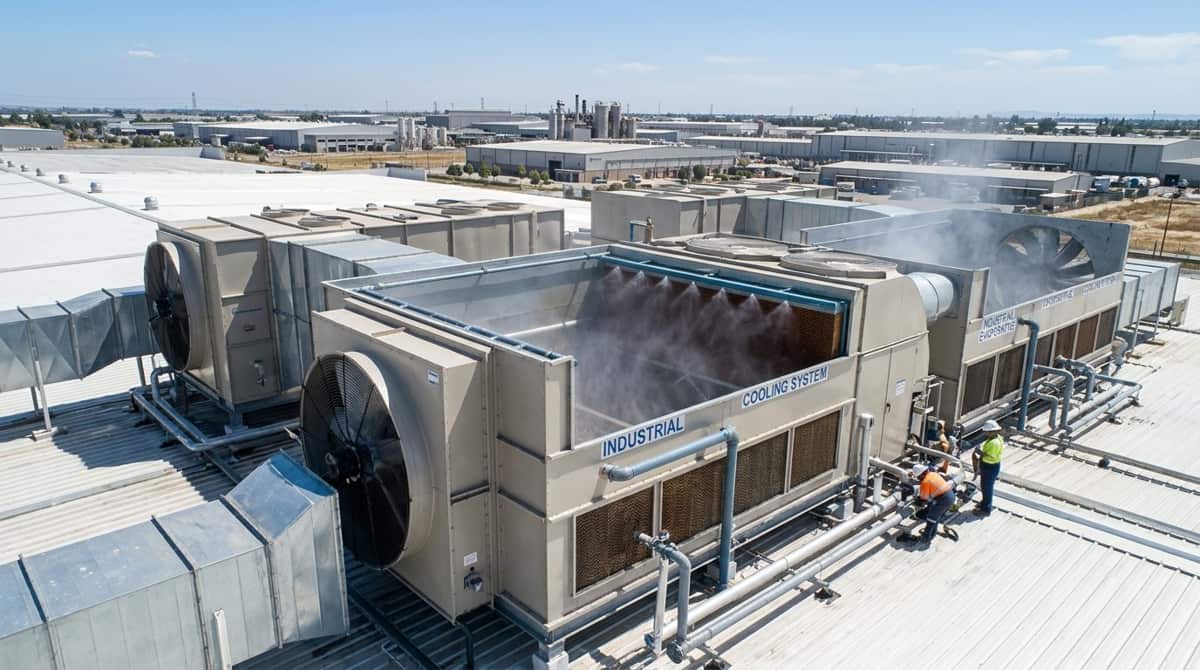
How Does an Industrial Evaporative Air Cooler Work?

If you’ve ever walked onto a garment factory floor in April, you already know the problem: hundreds of machines running, workers packed close together, and heat that just keeps building with nowhere to go. Standing fans move the hot air around, but they don’t actually cool it. This is usually the point where factory owners start asking about commercial evaporative air coolers and the first question is almost always the same one: how do these things actually work?
The short answer is simple. An industrial evaporative air cooler pulls hot air through water-soaked pads. As the water evaporates, it pulls the heat out of the air with it. What comes out the other side is air that’s noticeably cooler and a bit more humid than what went in. No gas, no compressor, no complicated refrigeration cycle, just water, airflow, and basic physics doing the work.
What Is an Industrial Evaporative Air Cooler?
An industrial evaporative air cooler is a large-capacity cooling unit built to bring down the temperature in big open spaces factory floors, warehouses, workshops, sheds by moving air through wet cooling pads. It’s sometimes called a desert cooler or an air washer, but it’s the same basic idea, just scaled up for industrial use.
It’s different from the small evaporative coolers you might see in a shop or a home. Industrial units are built to move far larger volumes of air, cover much bigger floor areas, and often connect to ducting so one machine can cool several rooms or zones at once.
It’s also a completely different technology from a split or central air conditioner. An AC unit cools air by running it over a refrigerant coil and removing moisture in the process. An evaporative cooler does the opposite: it uses water and evaporation, and it actually adds a bit of moisture to the air rather than taking it away. That one difference is the reason it works so well in some settings and not as well in others, which we’ll get into shortly.
The Science Behind It: Step by Step
The mechanism itself is easy to picture once you break it into stages:
- Hot air is pulled in. A powerful fan draws warm air from outside or from the factory environment into the unit.
- The air passes through wet cooling pads. These pads are kept constantly soaked by a small water pump that circulates water from a built-in tank.
- Evaporation happens. As the warm air moves through the damp pads, some of the water evaporates. Evaporation needs energy to happen, and that energy is pulled directly from the heat in the air passing through.
- Cooler air comes out. With the heat pulled out of it, the air that exits the other side is measurably cooler, often 8–15°C lower than the air that went in, depending on how dry the surrounding air was to begin with.
- The fan pushes it into space. The now-cooled air is blown into the factory floor or, in ducted systems, distributed through connected ducting to multiple areas.
This cycle keeps repeating continuously, which is why these units work best as a steady, always-on part of a space’s airflow rather than something switched on for a quick burst of cooling.
Key Components Explained
An industrial evaporative cooler is a fairly simple machine mechanically, which is part of why it costs less to run and maintain than AC. The main parts are:
- Cooling pads — usually made from high-efficiency evaporative cooling pads designed to hold water. and let air pass through slowly enough for evaporation to happen properly.
- Water pump and tank — keeps the pads continuously wet by circulating water from a reservoir, topping it up as it evaporates.
- Blower fan — the component that actually moves the air, sized to match how much floor space the unit needs to cover.
- Ducting (on larger installations) — channels the cooled air to different rooms or zones instead of releasing it all in one spot, useful for factories with multiple sections.
None of these parts require the specialized refrigeration know-how an AC technician needs, which is one reason maintenance tends to be simpler and cheaper.
Does Evaporative Cooling Work in Bangladesh’s Climate?
Evaporative cooling depends on dry air to work well. The drier the air going in, the more water can evaporate, and the more cooling you get. That means these units perform at their best during Bangladesh’s hot, dry pre-monsoon months, roughly March through May, when humidity is lower and temperatures are climbing fast. In these conditions, a well-sized industrial evaporative air cooler can make a real, noticeable difference on a factory floor.
During the monsoon months, when humidity is already high, the air can’t absorb as much additional moisture, so the cooling effect is weaker. This doesn’t mean the equipment is useless during that period, it still moves large volumes of fresh air through the space, which helps with ventilation but the temperature drop won’t be as dramatic as it is in drier weather.
Good airflow through the building also matters. These units work best in spaces with some cross-ventilation or exhaust points, so the warm, moist air they release has somewhere to go rather than building up and recirculating.
Evaporative Coolers vs Industrial AC vs Exhaust Fans
It helps to see these three side by side, since most factories end up choosing between them or combining them.
Industrial evaporative coolers cost significantly less to buy and run than AC, since there’s no compressor drawing heavy power. They work best in large, open, well-ventilated spaces and perform strongest in dry weather.
Industrial air conditioning delivers consistent cooling regardless of humidity, which makes it more reliable year-round, but it comes with a much higher upfront cost and electricity bill, and it works best in sealed, enclosed spaces rather than open factory floors.
Exhaust and ventilation fans don’t cool the air at all; they simply move it. They’re the cheapest option and are often used alongside evaporative coolers to help push warm, humid air out of the building rather than letting it recirculate.
Many Bangladeshi factories end up using a mix: evaporative cooling for the bulk of the floor space during dry months, paired with exhaust fans for airflow, and AC reserved for smaller, enclosed areas like offices or quality-control rooms where humidity control matters more.
Best Use Cases in Bangladeshi Industry
Evaporative cooling tends to shine in facilities that are large, open, and generate a lot of internal heat from machines or people. In practice, that covers a lot of ground in Bangladesh’s industrial landscape:
- RMG and garment factory floors, where dozens of sewing and cutting machines run continuously and worker comfort directly affects productivity.
- Warehouses and storage facilities, especially those with high ceilings where heat builds up and standard fans aren’t enough.
- Poultry sheds, where keeping birds cool during hot months is directly tied to their health and output.
- Plastics, rubber, and light manufacturing units, where machinery itself adds significant heat on top of the outside temperature.
- Workshops and assembly areas with limited natural ventilation and a lot of equipment-generated heat.
In most of these settings, the combination of open floor space and heavy internal heat load is exactly the environment where evaporative cooling performs best.
Energy and Cost Advantages
For a lot of factory owners, this is the section that decides everything. Industrial evaporative coolers typically use a fraction of the electricity that a comparable AC system would need, since they’re only running a fan and a small water pump rather than a power-hungry compressor. Running costs are usually a small percentage of what an equivalent-sized AC system would cost to operate over the same hours.
The upfront equipment cost is also generally lower, and installation is simpler since there’s no refrigerant line work involved. The trade-off, as covered above, is that the cooling effect varies with humidity so the savings are strongest when the equipment is used in the conditions it’s built for.
Maintenance and Common Issues
These units are relatively low-maintenance, but they do need regular attention to keep performing well:
- Cooling pads should be checked periodically and replaced when they start to harden, clog, or develop mineral buildup usually once every cooling season, depending on water quality and usage hours.
- Water quality matters. Bangladesh’s water hardness varies by area, and hard water can leave mineral deposits on the pads over time, reducing how well they hold moisture. A basic water filter or periodic tank cleaning helps extend pad life.
- Pump and tank should be inspected for leaks, blockages, or algae buildup, especially if the unit runs for long stretches without being switched off.
- Fan and motor need standard mechanical upkeep checking belts, bearings, and airflow output similar to any industrial fan system.
None of this requires specialized refrigeration technicians, which keeps ongoing maintenance costs and downtime lower than what AC systems typically require.
How to Choose the Right Capacity for Your Facility
Sizing an evaporative cooler correctly comes down to matching the unit’s airflow output to your floor space, ceiling height, and how much heat your equipment or process generates. A unit that’s too small won’t make a noticeable difference; one that’s oversized wastes water and electricity without added benefit.
As a starting point, it helps to know your floor area, ceiling height, and how many air changes per hour your space realistically needs factories with heavy machinery or dense worker areas generally need more air changes than a simple storage space. If you’re not sure how to work out those numbers, a quick facility assessment can settle it far more accurately than guesswork, and it’s worth doing before ordering equipment.
Conclusion
An industrial evaporative air cooler works by pulling hot air through water-soaked pads, using evaporation to draw the heat out before pushing cooler air back into your space. For large, open, well-ventilated facilities in Bangladesh garment floors, warehouses, poultry sheds, and workshops it’s often a far more affordable way to bring down temperatures than AC, especially during the hotter, drier months of the year.
If you’re not sure whether your facility is a good fit, or what capacity you’d actually need, it’s worth getting a quick assessment before deciding the right size makes all the difference in how well it performs.