

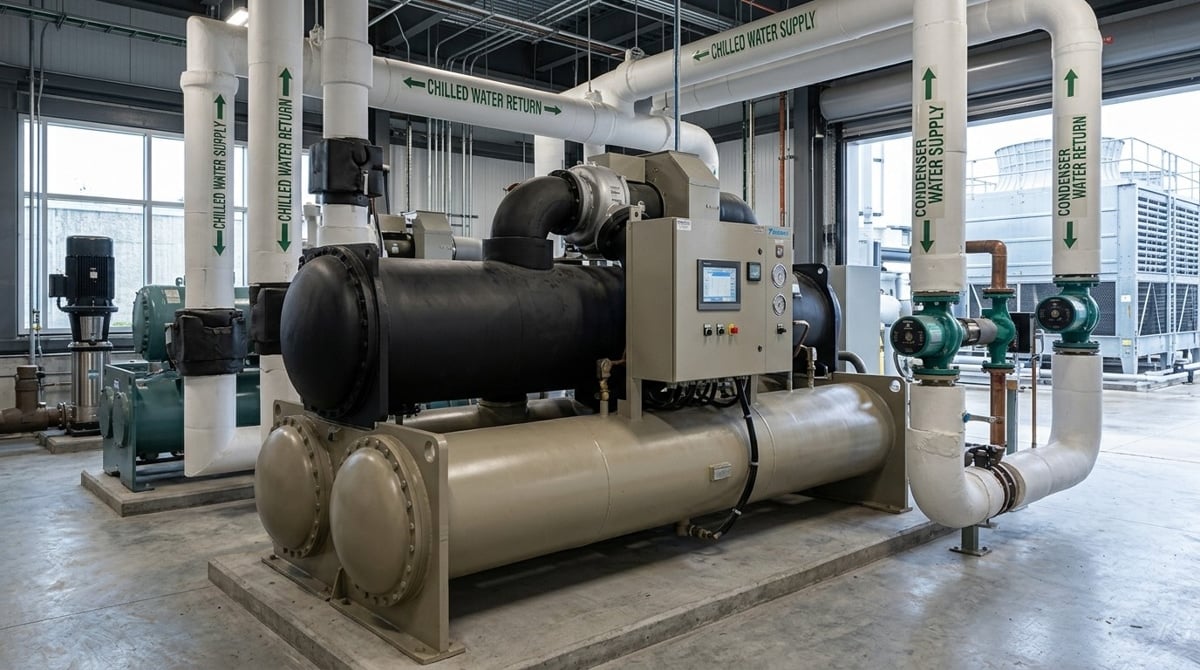
How Does a Water-Cooled Chiller Work in Bangladesh’s Industrial Facilities?

Walk into any dyeing unit in Gazipur, a pharmaceutical plant in Savar, or a plastics factory in Narayanganj on a humid July afternoon, and you’ll notice the same thing: the machines are working hard, the air outside is thick and hot, and somewhere in the background, a chiller is quietly deciding whether that day runs smoothly or turns into a production headache.
For a lot of factory owners and plant managers in Bangladesh, a chiller is one of those pieces of equipment everyone depends on but few people actually understand. You know it keeps things cool. You know when it breaks, production stops. But how it actually works and why the type of chiller matters so much in a country like ours often stays a mystery until something goes wrong.
What Is a Water-Cooled Chiller?
At its simplest, an industrial water-cooled chiller system is a machine that pulls heat out of water. That cooled water is then pumped through your factory into dyeing machines, injection molding equipment, pharmaceutical processing tanks, or air handling units to absorb heat from your process. Once that water picks up heat from your equipment, it comes back to the chiller to be cooled again, and the cycle repeats.
The “water-cooled” part refers to how the chiller itself gets rid of the heat it collects. Instead of blowing that heat into the outside air (like a window AC unit does), a water-cooled chiller sends it to a cooling tower, where it’s released using water and airflow together. This distinction matters a lot in Bangladesh’s climate, which we’ll get into shortly.
One common mix-up worth clearing up early: a water-cooled chiller is not the same as an air conditioner, even though both use refrigeration. A chiller is built to cool water for industrial processes, often running continuously, at a much larger scale than comfort cooling for a room.
The Working Principle: How a Water-Cooled Chiller Actually Cools
The easiest way to understand a chiller is to follow one drop of refrigerant through its journey because that’s really what’s happening on a loop, over and over, thousands of times an hour.
It starts in the evaporator. This is where the chiller absorbs heat from your process water, the water that’s been circulating through your factory equipment and has picked up heat along the way. As that warm water passes through the evaporator, a cold refrigerant inside the chiller absorbs the heat from it, and in doing so, the refrigerant turns from a liquid into a gas. The water, now cooler, gets pumped back out to your equipment to do its job again.
That refrigerant gas, now carrying the heat it just absorbed, moves to the compressor. The compressor’s job is simple but important: it squeezes the gas, raising its pressure and temperature significantly. Think of it like pumping air into a bicycle tire the more you compress it, the hotter it gets. This step is what allows the heat to be released later, because you can’t dump low-grade heat into water that’s already warm; you need to raise its temperature first.
Next, that hot, high-pressure gas travels to the condenser. Here, the heat transfers out of the refrigerant and into a separate stream of condenser water. This is the step that makes it a “water-cooled” chiller, because that condenser water then goes to a cooling tower outside, where it releases the heat into the atmosphere before coming back to do the job again. As the refrigerant gives up its heat in the condenser, it turns back into a liquid.
Finally, that liquid refrigerant passes through an expansion valve, which drops its pressure suddenly. This pressure drop cools the refrigerant right back down, ready to return to the evaporator and start the entire cycle again.
That’s the whole loop: absorb heat, compress it, release it, cool down, repeat running continuously as long as your factory needs cooling.
Key Components of a Water-Cooled Chiller System
It helps to know what each major part is actually doing, especially when you’re talking to a technician or supplier about your system.
The compressor is the heart of the system. It moves the refrigerant through the whole cycle and does most of the work (and uses most of the electricity). When people talk about chiller brand and quality, they’re often really talking about the compressor.
The evaporator system is where your factory’s processed water gets cooled. This is the part directly connected to your production equipment.
The condenser is where the heat that was absorbed gets handed off to the condenser water loop, on its way out of the system.
The cooling tower system Install sits outside, usually on the roof or in an open yard, and is where the heat picked up in the condenser is finally released into the outside air using evaporation. This is the part unique to water-cooled systems.
The condenser water pump and chilled water pump keep both water loops, the one going to the cooling tower and the one going to your factory equipment moving continuously.
Refrigerant is the substance that carries heat through the whole cycle, changing between liquid and gas as it absorbs and releases heat at each stage.
Together, these parts form a loop that’s designed to run for years with proper care, which is exactly why understanding each piece matters when you’re choosing a system or troubleshooting a problem.
Water-Cooled vs. Air-Cooled Chillers: Why the Difference Matters in Bangladesh’s Climate
This is where local conditions genuinely change the right answer.
An air-cooled chiller system rejects heat straight into the outside air, using large fans blowing across coils similar in principle to how a car radiator works. This works fine in cooler, drier climates. But in Bangladesh, especially from March through September, the outside air is often both hot and heavily loaded with moisture. That combination makes it harder for an air-cooled system to shed heat efficiently, because it’s fighting against air that’s already close to the temperature it’s trying to cool.
A water-cooled chiller has an advantage here because of how a cooling tower works. Instead of relying purely on air temperature, a cooling tower uses evaporation to release heat and evaporation is governed by something called wet-bulb temperature, which is almost always lower than the air temperature you feel, even on a humid day.In practical terms, this is the reason water-cooled chillers are efficient for handling heavy, continuous industrial loads in high humidity.
This isn’t to say air-cooled chillers don’t have their place for smaller loads or facilities with limited water access, they’re often the simpler, lower-maintenance choice. But for factories running large, continuous cooling loads through Bangladesh’s hot, humid months, water-cooled systems tend to hold their efficiency better, which is a big part of why they’re so common in larger industrial setups here.
Why Water-Cooled Chillers Are Common in Bangladeshi Industrial Facilities
Walk through the major industrial zones Gazipur, Savar, Narayanganj, Chattogram EPZ and you’ll find water-cooled chillers doing heavy lifting across several industries, each with its own reason for relying on them.
Textile and garment dyeing and finishing units need large volumes of temperature-controlled water for their processes, often running lines around the clock. The scale and continuous nature of this work suits water-cooled systems well.
Pharmaceutical manufacturing demands tight, consistent temperature control sometimes within very narrow tolerances because product quality depends on it. Reliability and precision matter more than upfront cost here.
Plastics and injection molding facilities use chilled water to cool molds quickly, which directly affects production speed and product quality. Faster, more consistent cooling means faster cycle times.
Food and beverage processing relies on chillers for both product cooling and maintaining hygienic processing temperatures, often with strict consistency requirements.
Across all of these, the common thread is scale and continuous operation. When a facility is running large cooling loads for long hours, day after day, the efficiency advantage of a water-cooled system tends to pay for itself over time which is why it’s become the standard choice for larger industrial operations across the country.
Operating Challenges Specific to Bangladesh and How They’re Managed
No cooling system runs in a vacuum, and water-cooled chillers here face a few conditions worth planning for from day one, rather than discovering the hard way.
Water quality and scaling. Local water sources vary in hardness, and minerals in that water can build up inside condenser tubes over time in a process called scaling. Left unmanaged, scaling reduces the chiller’s ability to transfer heat efficiently, forcing it to work harder and use more electricity to do the same job. This is manageable with proper water treatment and a regular tube-cleaning schedule, but it needs to be planned for rather than ignored.
Power reliability. Voltage fluctuations and occasional load-shedding put real stress on compressor motors, which are sensitive to sudden power changes. Facilities that pair their chillers with voltage stabilizers and soft-start systems tend to see far fewer compressor issues over the equipment’s lifetime than those that don’t.
Monsoon-season humidity. During the wettest months, cooling towers have to work harder because the surrounding air is already saturated with moisture, which slightly reduces how efficiently heat can be released. Well-sized systems account for this seasonal swing rather than being sized only for average conditions.
Access to qualified maintenance support. A water-cooled chiller has more moving parts than a simple air-cooled unit pumps, cooling tower fans, water treatment systems and having a technician nearby who understands the full system matters more here than it might elsewhere.
None of these are reasons to avoid water-cooled systems; they’re simply part of operating one responsibly in this environment, and each has a well-established solution.
Maintenance Practices That Keep a Water-Cooled Chiller Running Efficiently
Good maintenance isn’t complicated, but it does need to be consistent.
Condenser tube cleaning should happen on a schedule based on your local water hardness, not just “once a year” by default some facilities need it more often depending on their water source. This single practice has one of the biggest impacts on long-term efficiency.
Cooling tower water treatment keeps mineral buildup and biological growth under control, protecting both the tower and the condenser from scaling and fouling.
Refrigerant charge checks confirm the system has the right amount of refrigerant too little or too much both hurt performance and can strain the compressor.
Compressor servicing at manufacturer-recommended intervals catches small issues like bearing wear or minor vibration before they turn into expensive failures.
A chiller that receives this kind of routine attention will typically run more efficiently, use less electricity, and last considerably longer than one that’s only looked at when something breaks.
Choosing the Right Water-Cooled Chiller Supplier in Bangladesh
Once you understand how the system works, choosing a supplier becomes a much more informed decision and a few things matter more than the price tag on the quotation.
Local after-sales service is arguably the single most important factor. A chiller that goes down for a week because a technician had to travel from another city can cost far more in lost production than any savings from a cheaper upfront price.
Spare parts availability locally, especially for the compressor and major components, determines how quickly your system can be back up and running if something fails.
Compressor brand and reputation matter because the compressor is the part most likely to determine your system’s long-term reliability and running cost.
Correct sizing based on an actual load calculation for your facility, not just picking the tonnage that seems close enough prevents both under-cooling and unnecessary energy waste from an oversized system.
Warranty terms and installation support tell you a lot about how confident a supplier is in their own equipment and workmanship.
A supplier who walks you through these points honestly, rather than just pushing the lowest quote, is usually the one worth working with long-term.
Getting the Right Chiller for Your Facility
A water-cooled chiller isn’t complicated once you see it as a simple loop: absorb heat, move it, release it outside, repeat. What makes it work well or poorly in a Bangladeshi facility comes down to how well the system is matched to local water conditions, power reliability, and the specific demands of your production process.
If you’re planning a new installation or trying to figure out why your current system isn’t performing the way it should, the most useful next step is usually a proper load assessment and site evaluation, not just a quote based on tonnage alone. That’s where the real difference between a system that runs smoothly for fifteen years and one that causes recurring headaches gets decided.
If you’d like a second opinion on your cooling setup or a load assessment before you commit to a new system, contact Seraphic Associate. Our engineering team is happy to walk through your facility’s specific requirements and recommend what actually fits, not just what’s in stock.
Frequently Asked Questions
How long does a water-cooled chiller last?
With proper maintenance, a well-installed water-cooled chiller typically lasts 15 to 20 years. Compressors and major components may need servicing or replacement during that time, but the core system is built for long-term industrial use.
Is a water-cooled chiller more expensive to run than an air-cooled one?
Generally, no water-cooled systems tend to be more energy-efficient for large, continuous loads, especially in hot, humid conditions. They do require water treatment and cooling tower upkeep, which air-cooled systems don’t need.
What size chiller does a small-to-mid-sized factory need?
This depends entirely on your specific cooling load, which is calculated from your equipment, process temperatures, and facility size. A proper load calculation from a supplier is the only reliable way to determine this, guessing based on square footage alone often leads to an under- or over-sized system.
Can water-cooled chillers keep running during load-shedding?
Only if paired with a backup power source, like a generator, sized to handle the chiller’s startup and running load. Without backup power, any chiller water-cooled or air-cooled will stop when the power does.
Do water-cooled chillers need a lot of water?
They do use water continuously through the cooling tower, some of which is lost to evaporation and needs topping up. Facilities typically plan for this with a dedicated water supply or treatment system as part of the overall setup.