

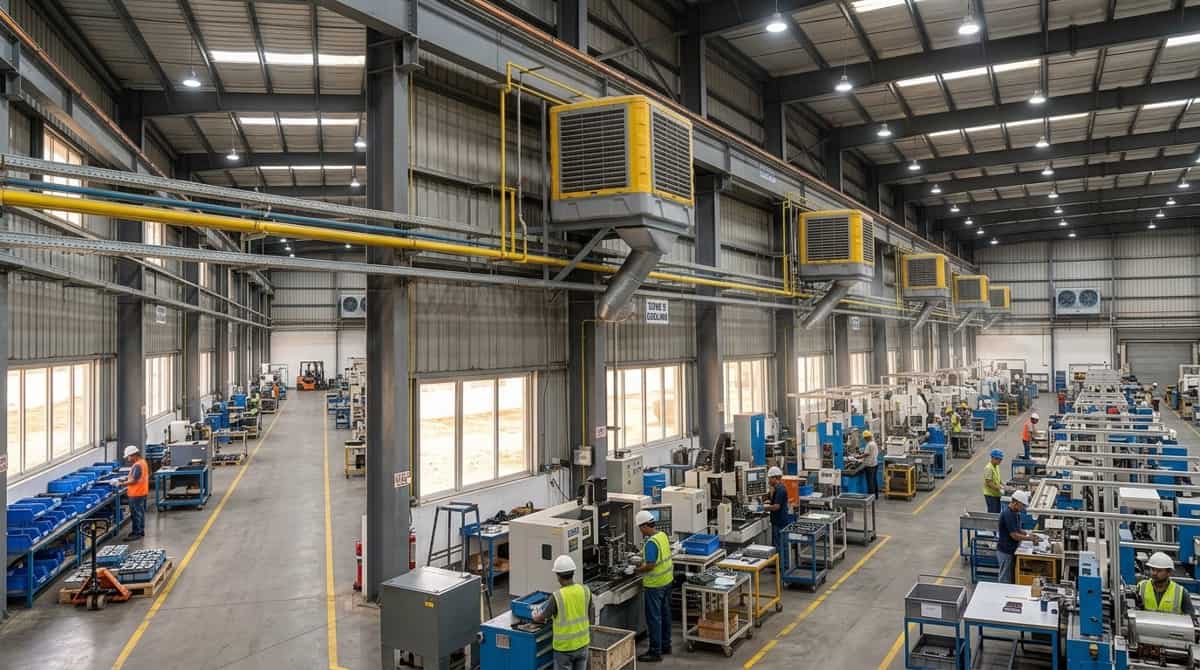
How Much Electricity Does an 18,000 CMH Industrial Evaporative Air Cooler Consume Per Hour?

An 18,000 CMH industrial evaporative air cooler typically uses about 1.0 to 1.5 kWh of electricity per hour. Most of that goes to one fan motor, with a small water pump adding very little. At an industrial rate of around Tk 12 per unit, that works out to roughly Tk 14 to Tk 18 per hour.
If you run a garment floor, poultry shed, workshop or warehouse in Bangladesh, you already know why this number matters. The summer heat slows your workers down, load-shedding pushes you onto the generator, and every extra unit on the bill counts. As an importer and supplier of industrial cooling equipment, we hear this question from factory owners almost every week. So here is the full answer: the real numbers, how to check them yourself, what it costs in Taka, how it compares with air conditioning, and how to spend less.
Power Consumption of an 18,000 CMH Evaporative Cooler
An 18,000 CMH energy-efficient industrial evaporative air cooler in Bangladesh uses about 1.0 to 1.5 kWh per hour. The fan motor (usually 0.75 to 1.1 kW) takes most of it, and the water pump adds only 40 to 150 watts. Run for 10 hours a day, that is roughly 10 to 15 kWh daily.
Here is how it breaks down:
| Component | Typical rating | Actual draw from the supply |
| Axial fan motor | 0.75 to 1.1 kW (1 to 1.5 HP) | about 0.9 to 1.3 kW |
| Water circulation pump | 40 to 150 W | 0.04 to 0.15 kW |
| Total | about 1.0 to 1.5 kW (so 1.0 to 1.5 kWh per hour) |
Why is the draw a bit higher than the motor rating? A motor labelled 1.1 kW delivers 1.1 kW of power at the shaft, but it pulls more from the supply because no motor is 100% efficient. Figures also vary from brand to brand, so always check the nameplate on the unit you are buying.
Where the Electricity Goes: Component-by-Component Breakdown
Understanding what is inside the cooler makes the numbers easier to trust.
Fan motor: the main load
The fan motor accounts for about 85 to 90% of the total electricity use. Most 18,000 CMH units use a three-phase motor running on 380 to 415 volts. Two things change how much it draws:
- Direct drive vs belt drive. Direct-drive fans have fewer moving parts and lose less energy. Belt-drive fans lose a little power in the belt and need more upkeep.
- Motor efficiency class. A better-built motor (IE2 or IE3) wastes less electricity as heat.
Water pump
The pump is a small submersible unit that lifts water from the tank to the cooling pads. It runs on anywhere from 40 to 150 watts, which is about the same as a ceiling fan or less. On your bill, it is barely noticeable.
Control panel and float valve
The switch panel and the float valve that tops up water use almost no power. You can ignore them when you calculate your costs.
What it does not have
This is the real reason evaporative coolers are cheap to run. They have no compressor and no refrigerant. An air conditioner spends most of its electricity running a compressor to push heat out of the room. An evaporative cooler simply pulls hot air through wet cooling pads, where water evaporation naturally cools it down. The only heavy work is moving air.
Tip: how to read the motor nameplate. Look for three things on the metal plate on the motor: kW (HP), amps and power factor. These three numbers are all you need for the calculation in the next section.
How to Calculate the Electricity Consumption Yourself
You do not have to rely on anyone’s word, including ours. You can work it out in two minutes.
Method 1: Using the motor rating
Power drawn (kW) = Motor rating (kW) ÷ Motor efficiency
Method 2: Using amps (more accurate)
Power (kW) = (1.732 × Voltage × Current in amps × Power factor) ÷ 1,000
A worked example
Suppose your cooler has a 1.1 kW fan motor with 85% efficiency and a 0.1 kW pump.
- Fan motor: 1.1 ÷ 0.85 = about 1.3 kW
- Pump: 0.1 kW
- Total: about 1.4 kW, which means about 1.4 kWh every hour
From there, daily and monthly use is simple:
| Running time | Electricity used |
| 1 hour | about 1.4 kWh |
| 10 hours a day | about 14 kWh |
| 26 working days a month (10 hours each) | about 364 kWh |
For the most honest figure, put a clamp meter on the running unit. An electrician can do this in a few minutes, and it shows exactly what your cooler draws on your own supply.
Running Cost in Bangladesh: How Much Will You Pay in Taka?
The cost depends on who supplies your power and which tariff category you are in. A factory on BPDB, DPDC, DESCO or a Palli Bidyut Samity (REB) connection can pay different rates, and industrial and commercial categories are priced differently.
To give you a realistic picture, the table below uses an illustrative range of Tk 10 to Tk 13 per kWh and a load of 1.4 kWh per hour.
| Running time | Electricity used | Approx. cost (Tk 10 to 13 per unit) |
| 1 hour | 1.4 kWh | Tk 14 to 18 |
| 10 hours a day | 14 kWh | Tk 140 to 182 |
| 16 hours a day | 22.4 kWh | Tk 224 to 291 |
| One month (26 days, 10 hours) | 364 kWh | Tk 3,640 to 4,732 |
Tariffs change, so please check your latest bill or ask your utility for the current rate before you plan your budget.
What if you run it on a generator?
During load-shedding, many factories switch to a diesel or gas generator. Power from a generator usually costs much more per unit than grid power. If we assume an illustrative Tk 35 per kWh, the same cooler costs about Tk 49 per hour, nearly three times the grid cost. That is why an efficient cooler matters even more if your generator runs for long hours.
What does it mean per worker?
Here is a simple example. Say one cooler serves a section with 40 workers. Running it for a 10-hour shift costs about Tk 140 to 182 in electricity, which is roughly Tk 4 per worker per day. If cooler air keeps people comfortable, working steadily and taking fewer breaks to escape the heat, that is a small price for the benefit.
Evaporative Cooler vs Air Conditioner: Electricity Comparison
This is the question we get right after “how much power does it use?” Here is an approximate comparison for a 1,000 sq. ft. factory floor with normal ceiling height, people and some machinery:
| 18,000 CMH evaporative cooler | Air conditioning (approx. 5 to 6 TR) | |
| Power draw | about 1.4 kW | about 5 to 7 kW |
| Monthly electricity (10 hrs × 26 days, at about Tk 12/unit) | about Tk 4,400 | about Tk 15,000 to 22,000 |
| Fresh air | Constant supply of outside air | Mostly recirculated air |
| Setup cost | Lower | Much higher, plus sealing the space |
These are rough figures. Your actual numbers depend on ceiling height, heat from machines, sunlight on the roof and how often doors open.
When comparing an industrial evaporative air cooler vs traditional AC in Bangladesh, it is fair to say the two serve different jobs. An AC is made for closed, sealed rooms such as offices, control rooms and sample rooms. . An evaporative cooler is made for large, open, ventilated spaces where hot air needs to be pushed out and fresh, cooler air brought in.
There is one trade-off to know about. An evaporative cooler adds some moisture to the air, while an AC removes it. In a very humid space, that matters, and we cover it below.
Factors That Change the Power Consumption
Two coolers with the same 18,000 CMH label can use different amounts of power. Here is why.
Motor rating and efficiency
A higher-efficiency motor (IE2 or IE3) costs a bit more at purchase but wastes less power every single hour. Over a few summers, the savings add up.
Voltage fluctuation and power factor
If your voltage drops or swings, a motor draws more current to do the same work. That heats the motor and raises your bill. Many factories in Bangladesh see this, especially at peak hours. A stabilizer or power-factor correction capacitor can help.
Duct length and static pressure
If the cooler pushes air through long ducts, bends or small outlets, the fan has to work harder. Its “18,000 CMH” rating is usually measured with little resistance. The more resistance in your setup, the lower the real airflow, or the higher the power use.
Pad condition and maintenance
Cooling pads clogged with dust or white scale from hard water block the airflow. The fan then struggles and cools less. Dirty pads are one of the most common reasons we see coolers underperform.
Speed control
A fixed-speed cooler runs at full power all the time. One with a variable frequency drive (VFD) or multi-speed switch can slow down when the weather is milder, and use much less power.
Weather
The cooler does not use more electricity on a humid day, but you get less cooling for every unit you pay for. We explain this in the climate section below.
6 Practical Ways to Reduce Your Electricity Cost
- Use a VFD or multi-speed control. Fan power falls sharply with speed. Slowing a fan by 20% can cut its power use by about half. That is a big saving for a small adjustment.
- Clean pads and remove scale regularly. Clean pads let air flow freely, so the motor works less.
- Place units properly and give hot air a way out. Open windows, vents or exhaust fans on the opposite side so air flows across the room. Without an exit, hot air stays trapped and the cooler works for nothing.
- Run units only when you need them. Use a timer or switch them on for the hottest hours rather than all day.
- Check wiring and power factor. Loose connections and a weak power factor waste electricity. Ask your electrician to check them once a year.
- Choose the right number of units. Too few units won’t cool the area. Too many waste power. A proper floor-area check gets it right the first time.
Is an 18,000 CMH Evaporative Cooler Right for Bangladesh’s Climate?
We would rather be upfront than sell you something that disappoints you.
Evaporative coolers work best when the air is hot and relatively dry. The cooler is only as good as the air’s ability to take in more moisture. Engineers talk about “wet-bulb temperature,” which simply means the lowest temperature that evaporation can bring the air down to. The drier the air, the lower that number, and the bigger the temperature drop you feel.
In Bangladesh, this means:
- March to May (pre-monsoon): Hot, with drier afternoons. This is when evaporative coolers perform best.
- June to September (monsoon): Very humid. You will still get fresh air and some cooling, but the temperature drop is smaller.
Good fits: RMG sewing floors, poultry sheds, workshops, warehouses and kitchens, where there is plenty of space, fresh air and ventilation is welcome.
Not the best choice: Sealed rooms, very humid spaces, or places that need exact temperature and humidity control. For these, AC or a dehumidifying system is better.
Quick Buying Checklist Before You Order
Before you place an order, ask the supplier:
- What is the motor’s nameplate kW, and what is the CMH at a stated static pressure?
- Which motor brand is used, and what is its efficiency class?
- What pad material and thickness does the unit use?
- What warranty is offered, and are spare parts available in Bangladesh?
- Will you provide installation support and a power-consumption test report?
Not sure what size or how many units you need? Contact us for a free load and floor-area assessment. Tell us your floor size and ceiling height, and we will help you work it out.
Conclusion
An 18,000 CMH industrial evaporative air cooler uses about 1.0 to 1.5 kWh per hour. That is around Tk 3,600 to Tk 4,700 a month at typical industrial rates for 10 hours a day, and far less than air conditioning for the same large space. You can lower the bill further with a speed control, clean pads and a well-planned layout.
Ready to find out what your factory needs? Contact our team to request a quote or a site assessment, and we will help you choose the right cooler for your space and budget.
Frequently Asked Questions
How many units (kWh) does an 18,000 CMH cooler use in a month?
At about 1.4 kWh per hour, running 10 hours a day for 26 days, it uses roughly 364 kWh a month. Your actual figure depends on the motor, running hours and conditions.
Can it run on a generator or solar, and what capacity is needed?
Yes. For one unit, plan on a generator of about 3 to 5 kVA, because motors draw extra power at startup. Solar needs a suitable inverter and panels, often around 3 to 5 kWp. Confirm with your supplier.
Does it need a three-phase connection?
Most 18,000 CMH industrial coolers use three-phase motors (380 to 415V). Some models come in single-phase. Check the model’s nameplate before ordering, and ask a licensed electrician to do the wiring and earthing.
How much water does it consume per hour?
On a hot, dry day, expect roughly 40 to 70 litres per hour. It varies with temperature, humidity and how much water is drained to keep the pads clean.
Is it cheaper to run than an AC in Bangladesh?
Usually, yes. For a large, open space, an evaporative cooler often uses a quarter to a third of the electricity an AC would need. It suits different spaces, though, so choose by the room type.