

How to Calculate Cooling Tower Capacity for Your Factory

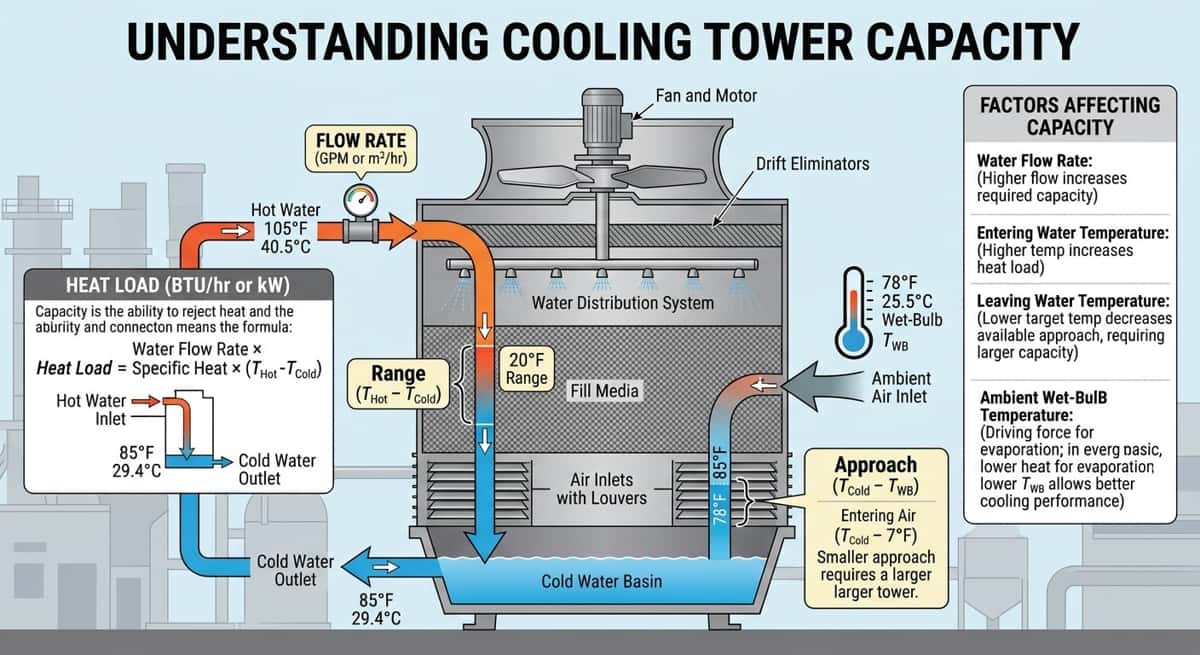
Your cooling tower’s capacity is the amount of heat it can remove from your factory’s hot water, usually written in kW or TR (tons of refrigeration). To find it, you need three things: how much heat your machines produce, how much water flows through the tower, and how hot the air is in your area.
Getting this right matters more than most people expect. A tower that is too small lets water run hot, so chillers and machines work harder, output drops and electricity bills climb. A tower that is too big costs more to buy, more to run, and more to maintain.
What Does Cooling Tower Capacity Actually Mean?
A cooling tower removes heat from water. Hot water from your chiller, compressor, furnace jacket or process machine goes in, cooler water comes out, and the same water is used again. Capacity tells you how much heat the tower can throw away every hour.
You will see capacity written in a few different ways:
- kW (kilowatts): the most common unit worldwide
- TR (tons of refrigeration): common for chiller systems. 1 TR = 3.517 kW = 12,000 BTU/h
- kcal/h: still used by many older machine manuals. 1 kW = about 860 kcal/h
- m³/h: the amount of water flowing through the tower
One thing trips up many buyers. A “cooling tower ton” is not the same as a refrigeration ton. It is commonly taken as 15,000 BTU/h, which is bigger than a refrigeration ton. The reason is simple: if you have a water-cooled chiller, the tower must remove the cooling load plus the heat added by the compressor. Always ask a supplier which “ton” they mean before comparing prices.
Key Terms You Must Know Before Calculating
Five simple terms come up in every cooling tower conversation.
| Term | What it means in plain words |
| Range | How many degrees the tower cools the water. If water enters at 38°C and leaves at 33°C, the range is 5°C. |
| Approach | How close the cooled water gets to the air’s wet-bulb temperature. If water leaves at 33°C and the wet-bulb is 29°C, the approach is 4°C. |
| Wet-bulb temperature | The lowest temperature water can reach by evaporation. It depends on both heat and humidity, so it is higher on sticky, humid days. |
| Circulating water flow | How much water moves through the tower each hour, in m³/h. |
| Cycles of concentration | How many times the minerals in the water build up before you drain some off. Higher numbers save water but raise scaling risk. |
Why wet-bulb and not the normal air temperature? A cooling tower works by evaporating a little water. On a humid day, evaporation is slower, so the tower cools less. That is why a smaller approach, meaning water cooled closer to the wet-bulb, needs a much larger tower.
Step-by-Step: How to Calculate Cooling Tower Capacity
Step 1: Find Your Heat Load
Start by listing everything that sends heat into your cooling water. Common sources in Bangladeshi factories include:
- Water-cooled chillers and air compressors
- Injection moulding and extrusion machines
- Furnaces and induction heaters
- Dyeing and finishing machines
- Generators and engines
You can find the heat figures on equipment nameplates, supplier datasheets, or the manual. If you have a chiller, remember the rule above: heat to reject = cooling load + compressor power. If the numbers are missing, ask the machine supplier for the “heat rejection” value. Add up the load from every machine that shares the same tower.
Step 2: Calculate the Water Flow You Need
Here is the formula that connects heat load, water flow and range:
Flow (m³/h) = Heat load (kW) ÷ (1.163 × Range in °C)
The number 1.163 comes from the way water absorbs heat. You do not need to remember why, just use it. Most chiller and process systems are designed for a range of about 5°C, though your equipment maker will tell you the exact figure for your machines. A bigger range means less water to pump, but a harder job for the tower.
Step 3: Set Your Range and Approach for Bangladesh
Now decide the temperatures your tower must deliver. You need three numbers:
- Design wet-bulb temperature: Bangladesh is hot and humid, especially from April to October, so this number is high. Get the right value from Bangladesh Meteorological Department records or ask your supplier which figure they design for in your district. Do not guess, because a lower number than reality means an undersized tower.
- Approach: A common choice is around 4°C. Going lower (say 2°C) can make the tower far bigger and much more expensive.
- Range: Taken from your equipment, usually about 5°C.
Example: wet-bulb 29°C + approach 4°C = cold water leaving the tower at 33°C. Add a 5°C range and hot water enters at 38°C.
Step 4: Add a Safety Margin and Room to Grow
Factories grow. A new machine next year should not force you to buy a second tower. Adding a margin of around 5–10% on top of your calculated load is a sensible, common practice. Adding 30% or 40% “just to be safe” mostly wastes money, since you pay more upfront and run bigger fans and pumps every day. If you plan a real expansion, size for it openly instead of hiding it in a big margin.
Step 5: Estimate Makeup Water and Blowdown
A cooling tower loses water in two ways, and you must replace both.
- Evaporation: the water that turns to vapour and does the cooling. A handy estimate is: Evaporation (m³/h) ≈ 0.00153 × Flow (m³/h) × Range (°C)
- Blowdown: water you drain on purpose to stop minerals building up. Blowdown = Evaporation ÷ (Cycles of concentration − 1)
Makeup water = Evaporation + Blowdown (plus a small amount lost as drift, which is usually minor in a good tower).
This step matters in Bangladesh, where groundwater costs, hardness and pumping power all add up.
Sizing a Tower for a Mid-Size Factory
A garment-washing plant runs one water-cooled chiller with a 200 TR cooling load. It works 16 hours a day.
Inputs
| Item | Value |
| Chiller cooling load | 200 TR |
| Chiller compressor power (assumed) | 130 kW |
| Design wet-bulb (assumed) | 29°C |
| Approach | 4°C |
| Range | 5°C |
| Cycles of concentration (assumed) | 4 |
Calculation
- Cooling load in kW: 200 × 3.517 = 703 kW
- Heat to reject: 703 + 130 = 833 kW (about 237 TR)
- Water flow: 833 ÷ (1.163 × 5) = about 143 m³/h
- Temperatures: water leaves at 33°C (29 + 4) and enters at 38°C (33 + 5)
- Add 10% margin: about 916 kW and about 157 m³/h. Ask suppliers for a tower rated at these conditions.
- Evaporation: 0.00153 × 143 × 5 = about 1.1 m³/h
- Blowdown: 1.1 ÷ (4 − 1) = about 0.37 m³/h
- Total makeup water: about 1.46 m³/h, or roughly 23 m³ per day over 16 hours
That last figure is the one many owners forget. Over a year, it becomes a real utility cost, which is why water-saving choices like better water treatment are worth discussing with your supplier.
Bangladesh-Specific Factors That Change Your Sizing
Textbook formulas are only half the story. Local conditions change what works.
- Heat and humidity: High wet-bulb temperatures in the pre-monsoon and monsoon months mean your tower works hardest exactly when you need it most. Size for the worst normal days, not the average.
- Water quality: Hard water or water with high iron causes scale on the fill and pipes, which lowers cooling over time. Test your source water before you finalize the design.
- Electricity cost and supply: Fans and pumps run for many hours. Efficient motors and good fan design can save real money, and stable power protects your equipment.
- Limited space: Many factories have a tight rooftop or a small yard. Tell your supplier early so they can suggest a shape and layout that fits, and check that your roof can carry the weight of a full tower.
- Discharge rules: Blowdown water leaves your site, so check the Department of Environment requirements that apply to your factory and confirm them with your consultant before you finalize the system.
Common Sizing Mistakes to Avoid
- Using normal air temperature instead of wet-bulb. This is the most common error and it leads to a tower that is too small on humid days.
- Forgetting the compressor’s heat. A 200 TR chiller needs a tower for more than 200 TR.
- Sizing only for today. If you plan another line in two years, mention it now.
- Ignoring dirt and scale. A tower loses performance as it ages. Ask about water treatment and cleaning.
- Skipping a site visit. Drawings do not show blocked airflow, nearby walls or hot exhaust air from other equipment, all of which affect real performance.
How to Choose the Right Cooling Tower After You Calculate
Once you have your numbers, you are ready to compare towers.
Construction: FRP (fibreglass) towers resist rust and are popular for lighter, quicker installation. RCC (concrete) towers suit very large, long-life plants. Steel towers are common in some industrial settings but need good corrosion protection.
Design: Counterflow towers usually take less floor space and suit tight sites. Crossflow towers are often easier to inspect and clean. An open tower is more efficient and costs less, while a closed-circuit tower keeps your process water clean and is better when contamination is a concern.
Ask every supplier these questions:
- Will you guarantee performance at my design wet-bulb, flow and temperatures?
- What fill and drift eliminator do you use, and how long do they last?
- Which brand are the fan, motor and gearbox?
- Are spare parts available in Bangladesh, and how quickly?
- Who handles installation, commissioning and after-sales service?
- What does the warranty cover, and for how long?
- What is the delivery timeline from order to site?
A supplier who answers these clearly is usually one you can trust.
When to Involve a Qualified Engineer
The formulas in this guide give you a solid estimate, and they will help you ask better questions. They are not a final design. A cooling tower is a significant investment, and it affects your production, your water use and the health and safety of your people. That’s why choosing the right cooling tower providers for factories in Bangladesh is essential for reliable performance, efficient water use, and long-term operational safety. For example, poorly maintained warm water systems can grow harmful bacteria such as Legionella, so a good water treatment and cleaning plan matters.
Before you place an order, have a qualified mechanical engineer or your supplier’s technical team check your numbers on site. If you would like help, our team can review your load and give a free sizing opinion. Contact us or send us your equipment data sheets.
Your 5-Step Checklist
- Find your total heat load, including compressor heat for chillers.
- Work out the water flow using the heat load and range.
- Set the wet-bulb, approach and range for Bangladesh’s climate.
- Add a sensible 5–10% margin for growth.
- Estimate makeup water and blowdown so there are no surprises on your utility bill.
Ready to put your numbers to work? Request a quote and technical consultation. With experience in industrial cooling solutions, Seraphic Associate helps businesses evaluate their options and choose a cooling tower that fits their factory, budget, and water supply.
Frequently Asked Questions
How many TR cooling tower do I need for my factory?
It depends on your heat load. For a water-cooled chiller, take the chiller’s cooling load, add the compressor’s power, and convert to your preferred unit. As a rough guide, the heat to reject is often around 1.2 to 1.3 times the chiller’s cooling load.
Can I size a new tower from my old tower’s nameplate?
It is a good starting point, but not enough on its own. Your loads may have changed, and an old tower may have lost performance. Check your current heat load and flow before you copy the old rating.
What is a good approach temperature?
Many systems are designed with an approach of about 3°C to 5°C. A smaller approach means a bigger, costlier tower, so choose the figure your process really needs.
How often should I check my tower’s capacity?
Check water temperatures and flow regularly, and inspect fill, nozzles and fans at least every few months. A clear drop in cooling usually points to scale, dirt or a mechanical problem.