

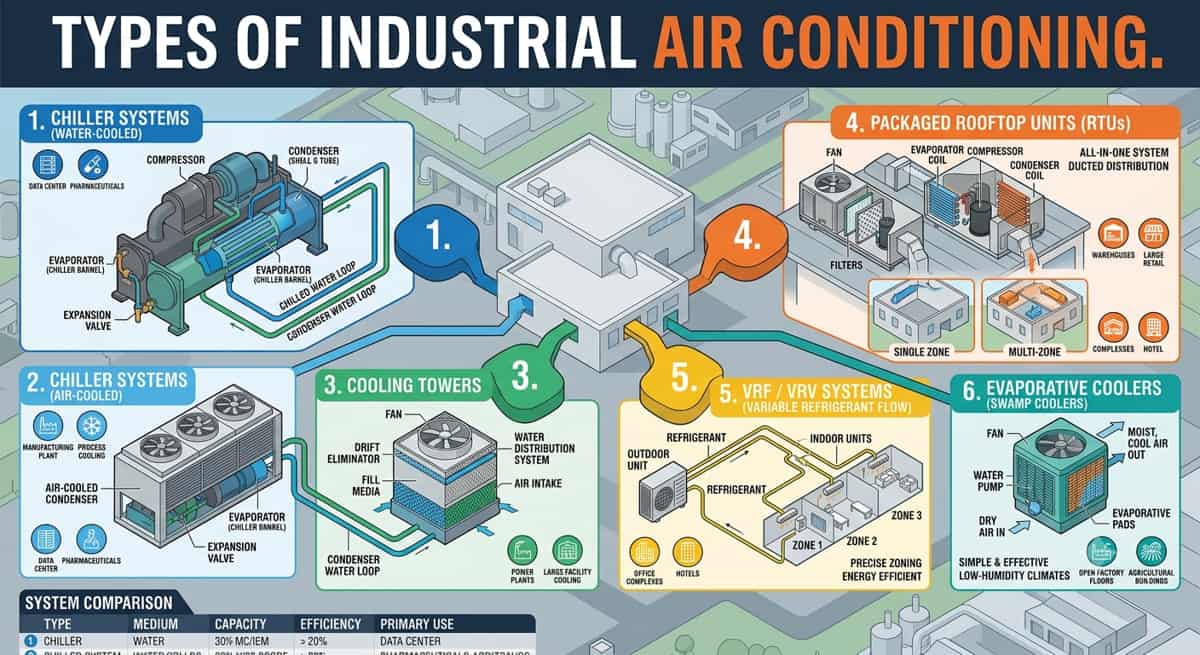
Types of Industrial Air Conditioning Systems in Bangladesh

The climate you are battling running an industrial facility in Bangladesh Outdoor temperatures routinely soar over 35°C for months on end as heavy tropical humidity traps hot air inside. This is an environment that rapidly expands inside of a factory. By noon, sans preferred climate control, a garment floor turns into the proverbial oven making working conditions unsafe and productivity to plummet. In precision sectors like pharmaceuticals, a single temperature spike in a storage room can ruin entire batches of life-saving medicine by degrading raw materials. The threats for food processing units are no different: spoilage, bacterial growth and being out of regulatory compliance within an hour if cooling systems fail.
Running an industrial plant here isn’t just turning on the lights it’s a constant fight to save your workers, your inventory and equipment from punishing ambient heat. Traditional means of cooling often fail or stress the power grid, leading operations managers to search for clever high efficiency engineering solutions. In order to maintain profitability and compliance with facility requirements, you require a thermal management strategy that is specific for the unforgiving high-humidity climate of Bangladesh.
Why Industrial Cooling Is Critical for Bangladeshi Industries
The weather is not hot but humid at Bangladesh and this led to an extra burden on people and equipment. Because high humidity hampers the ability of machines to shed heat, factories with heavy machinery like textile dyeing units or printing presses often operate even hotter than the surrounding air would indicate.
In addition to comfort, cooling influences safety and compliance. Hot workplaces raise risks of fatigue, accidents and ill health among workers, leading many international buyers to mandate that factories don’t exceed certain temperature and humidity limits before placing any orders. For pharmaceutical and food industries, the stakes are even higher. If we store the medicines above the recommended temperatures, they can lose their potency, and perishable food products require consistent humidity control to avoid spoilage. It’s not an optional exercise, it’s one of the pillars that allows for a safe, legal and reliable operation.
Main Types of Industrial Air Conditioning Systems
1. Central Air Conditioning (Chiller-Based) Systems
Central air even regional geographic ranges are from one central plants to cool a facility, a large chiller that makes chilled water or refrigerant and is transported through the building via air handling units/ductwork. Rather than multiple units for each room, only one huge system serves the entire building.
This arrangement is ideal for large factories with spacious floors, such as clothing manufacturing units where hundreds of personnel and machines need continuous cooling across a wide expanse. Biggest positive aspect is it cools very large area quickly and uniformly, and can be controlled from a single point.
The con is the initial cost. You need to pay more up front for central systems and they require installation by pros, but if the chiller goes down the entire building may be cooled at once. Of course, this incurs a higher Initial spend but at an industrial scale, the efficiency is worth the upfront investment in the long-run.
2. VRF/VRV (Variable Refrigerant Flow) Systems
VRF (also referred to as VRV) systems involve one outdoor unit with several indoor units that can be separately controlled. This allows you to cool one part of your facility to a different temperature than another at the same time from the same system.
The versatility of VRF makes it particularly suitable for buildings that combine industrial and office spaces such as a factory together with an administration block, showroom or quality control lab. Running independently of each other means that energy won’t be wasted cooling areas that aren’t currently in use, keeping those electricity bills a bit less daunting. In addition, VRF systems are recognized for their energy efficiency compared to older central systems and require less space because large ductwork is not needed throughout the building.
The key to remember is whether your space will be able to provide the proper zoning with a VRF system you need mid-sized as opposed to large open factory floors and installation needs to be done by experienced techs.
3. Chilled Water Systems
Chilled water systems are used in a similar way to central air conditioning except that they are specifically designed to circulate chilled water through piping network to cool large or distributed spaces. Water is cooled by a central chiller and pumped to fan coil units located around the building.
Such a system is used in large textile plants and wider pharmaceutical plants in Bangladesh because it has very high cooling load reliability (across multiple stories or production halls). It’s also ranked one of the more reliably sound solutions for continual, always-on usage which is really important in industries that can’t allow any downtime during production.
As a rule of thumb chilled water systems take up more room for pipework and need their own plant room so a larger investment to begin with. But for those facilities requiring serious, reliable cooling capacity, they’re still one of the most trusted names in heavy industry.
4. Packaged/Rooftop Units
Packaged/Rooftop Units
Packaged, or a rooftop unit integrates all the refrigeration part (compressor, condenser and evaporator) in one order either installed on the roof or just outside of the building. These are easier to instal than central or chilled water systems because everything is self-contained.
They are particularly useful for warehouses and single-storey factories with limited floor space and no indoor equipment taking up valuable production real estate. It is also nice that, because the unit is outside of the facility itself, it saves wall and ceiling space for other uses.
If your cooling needs are straightforward and you prefer solid air conditioning without the complexity of a centralized system with ductwork, packaged units are a practical and affordable alternative although they fit best in small or medium buildings as opposed to large multi-zone facilities.
5. Ducted Split & Cassette Systems
Ducted split systems and ceiling cassette units are smaller-scale solutions best used for offices inside a factory compound, sample rooms, quality control areas, or retail showrooms adjoined to a manufacturing unit. Ducted splits push air through concealed ducting for a neat finish, and cassette units are recessed in the ceiling and provide even top-down cooling of the room.
Because the systems are inexpensive, relatively easy to install by a contractor without requiring significant structural alterations and do not need that scale of zone control, they tend to be chosen for smaller, less expansive spaces that are more completely enclosed as opposed to common open areas where central or VRF would be appropriate. The trade-off is capacity. They are not meant for cooling larger, open industrial floors, hence they are best as a part of wider system vs stand-alone solution for the whole factory.
6. Precision/Process Air Conditioning (Cleanrooms, Pharma, Data Centers)
There are industries that cannot tolerate even small fluctuations in temperature or humidity. This can be seen in pharmaceutical manufacturing, cleanroom environments, and data centers where precision air conditioning systems are constructed to withstand ultra-tight stable conditions 24/7.
These systems are designed to comply with stringent environmental specifications that may be associated with Good Manufacturing Practice (GMP) standards for drug manufacturing facilities or special cleanroom classification depending on the type of product produced. Due to the very low error margin, precision systems almost always come with additional features such as increased monitoring, backup capacity and more stringent humidity control than conventional industrial AC equipments.
Figure out if your facility is in this category, and if so it pays to engage with suppliers that know the particular regulatory standards relevant for your sector because messing this up doesn’t mean just some discomfort but batch failure or non-compliance.
7. Evaporative & Industrial Cooling Systems
An evaporative cooling system operates by passing air through a set of pads that are soaked with water, which cools the air through evaporation before blowing it into the space. They are a much cheaper type of air conditioning and consume a tiny fraction of the electricity, something that is important for Bangladesh with its rapidly rising energy costs.
This makes them interesting for businesses with limited budgets or companies located in comparatively dry regions of this nation. The problem is that evaporative cooling becomes ineffective at high humidity, which is typical for much of Bangladesh for most of the year. Therefore, although a low-cost option that is probably relevant for some applications (i.e. large warehouses or semi-open industrial spaces), the quick fix of moving toward desiccants is probably not appropriate if end product quality relies on humidity control (textile dyeing or pharmaceutical storage).
Comparison Table – Which System Fits Which Industry?
Here’s a quick side-by-side view to help you narrow down your options before getting into deeper technical discussions with a supplier.
| System Type | Best For | Capacity Range | Energy Efficiency | Approx. Cost Tier |
| Central (Chiller-Based) | Large garment/RMG factories | Very high | Moderate to good | High |
| VRF/VRV | Mixed industrial + office spaces | Medium to high | Very good | Medium to high |
| Chilled Water | Large textile/pharma plants | Very high | Good | High |
| Packaged/Rooftop | Warehouses, single-story units | Medium | Moderate | Medium |
| Ducted Split & Cassette | Offices, showrooms, small rooms | Low to medium | Good | Low to medium |
| Precision/Process AC | Cleanrooms, pharma, data centers | Medium | Good (with added stability) | High |
| Evaporative Cooling | Dry zones, semi-open warehouses | Medium to high | Excellent | Low |
How to Choose the Right System for Bangladesh’s Climate & Power Conditions
- Choosing a system isn’t merely a numbers game of cooling power on paper. But there are several practical considerations unique to Bangladesh that should guide your decision:
- Regional heat and humidity levels: Coastal and southern areas generally handle more humid conditions than their northern counterparts, which details how impactful certain systems specifically evaporative one will be.
- Power reliability & Load shedding: If your area faces a recurring power loss, it may be worthwhile to prepare for backup power capacity or set up systems that can easily restart with no damage after outages.
- Different requirements for industries: What a textile factory has to look like is very different than what a pharmaceutical warehouse will have. You need to make the system match your true production process, not just the size of your building.
- BSTI and local compliance standards: Verify that the equipment you install complies with pertinent Bangladesh Standards and Testing Institution (BSTI) regulations, as well as any industry-specific safety certifications your buyers or regulators expect.
- Cost of ownership vs. price: An inexpensive system today can prove expensive over five years as the electricity bill climbs and repairs become more frequent. Remember that the initial purchase price is only a small factor in the overall long-term running costs of any car.
Import & Cost Considerations for Industrial AC in Bangladesh
Most industrial air conditioning equipment used in Bangladesh is imported, which means import duties, shipping timelines, and after-sales support all factor into your total cost and experience. Duty rates vary depending on the type and specification of equipment, so it’s worth confirming current NBR (National Board of Revenue) rates with your supplier before finalizing a budget, since these can change.
One of the biggest risks buyers face is sourcing from unreliable or grey-market channels. Units brought in without proper documentation or manufacturer backing often come with no valid warranty, no access to genuine spare parts, and no local servicing support, which becomes a serious problem the moment something breaks down. Working with an established, licensed importer typically means clearer lead times, proper warranty coverage, and a local team that can actually service your equipment when needed, rather than leaving you stranded after installation.
Before committing to a purchase, ask your supplier directly about expected delivery timelines, what the warranty covers, and whether they maintain local stock of spare parts and trained technicians. These answers tell you a lot about how the relationship will go after the sale.
Maintenance & Energy Efficiency Tips
Even the best system will underperform without regular upkeep. A few habits go a long way in Bangladesh’s dusty, humid conditions:
- Clean or replace air filters every 4–6 weeks in high-dust environments, since clogged filters force the system to work harder and use more electricity.
- Schedule refrigerant level checks at least twice a year, since low refrigerant is one of the most common causes of reduced cooling performance.
- Inspect and clean condenser coils seasonally, especially before the peak summer months, since dirt buildup significantly reduces efficiency.
- Check drainage lines regularly during monsoon season to prevent water damage or mold buildup around indoor units.
- Keep a basic maintenance log for each unit so patterns, like a specific unit needing repairs more often than others, become easy to spot early.
Consistent maintenance doesn’t just prevent breakdowns, it directly lowers your electricity costs, which matters given how much cooling can add to an industrial facility’s monthly power bill.
How to Choose a Reliable Industrial AC Supplier in Bangladesh
Choosing the right industrial AC supplier in Bangladesh is just as important as selecting the system itself. A reliable supplier provides genuine products, expert installation, dependable after-sales support, and solutions tailored to your facility’s cooling needs.
The supplier you choose matters just as much as the system itself. Here’s what’s worth checking before you commit:
- Certifications and standards compliance: Confirm the supplier’s equipment meets BSTI and relevant international standards for your industry.
- Brand partnerships: Established relationships with recognized manufacturers usually mean better access to genuine parts and warranty support.
- Installation and service network: Ask whether they have technicians available in or near your region, not just in Dhaka, especially if your facility is elsewhere in the country.
- After-sales support: A supplier who disappears after installation leaves you exposed. Look for clear warranty terms and responsive service commitments.
- Client references: Ask for examples of similar projects they’ve completed, ideally in your industry, so you can see how they’ve handled comparable needs before.
Taking the time to vet a supplier properly upfront saves a lot of frustration later, especially if something needs urgent repair during peak production season.
Conclusion & Next Steps
Understanding the right industrial air conditioning in Bangladesh is about pairing your facility’s need size, industry type, climate zone, and power situation to the system built to take it whether central chiller for a massive garment factory or VRF system for a mixed-use building or precision unit AC for pharmaceutical clean rooms. This is a capital decision that impacts your workers, your products and ultimately the bottom line.
And if you still need help deciding who to go with or would prefer that we recommend something based on your unique facility we are happy to talk through your needs and get you matched up.
Frequently Asked Questions
What is the best industrial AC system for garment factories in Bangladesh?
For large garment factories with big, open production floors, central air conditioning or chilled water systems tend to work best because they can cool large areas evenly and handle continuous operation reliably.
How much does an industrial air conditioning system cost in Bangladesh?
Costs vary widely depending on system type, capacity, and building size, ranging from relatively affordable evaporative or split systems to significant investments for central or chilled water setups. It’s best to get a facility-specific quote based on your actual cooling load.
Which industrial AC type works best during load-shedding?
Systems paired with reliable backup power, like generators or battery backup for critical zones, handle load-shedding best. VRF and packaged units often restart more smoothly after short outages compared to some older central systems.
Can evaporative cooling work in Bangladesh’s humid climate?
It can work in drier regions or semi-open spaces, but it becomes far less effective in high-humidity areas, which covers much of the country for a large part of the year. It’s generally not recommended for humidity-sensitive industries like textiles or pharmaceuticals.
Do pharmaceutical facilities need a special type of air conditioning?
Yes. Pharmaceutical manufacturing and storage typically require precision or process air conditioning systems that maintain very tight temperature and humidity control in line with GMP guidelines, rather than standard industrial cooling systems.
How often should industrial AC systems be serviced?
Filters should be checked every 4–6 weeks in dusty environments, while refrigerant levels and condenser coils should be inspected at least twice a year, ideally before peak summer demand.