

How Air Curtains Help Reduce Dust and Insects in Commercial Buildings in Bangladesh

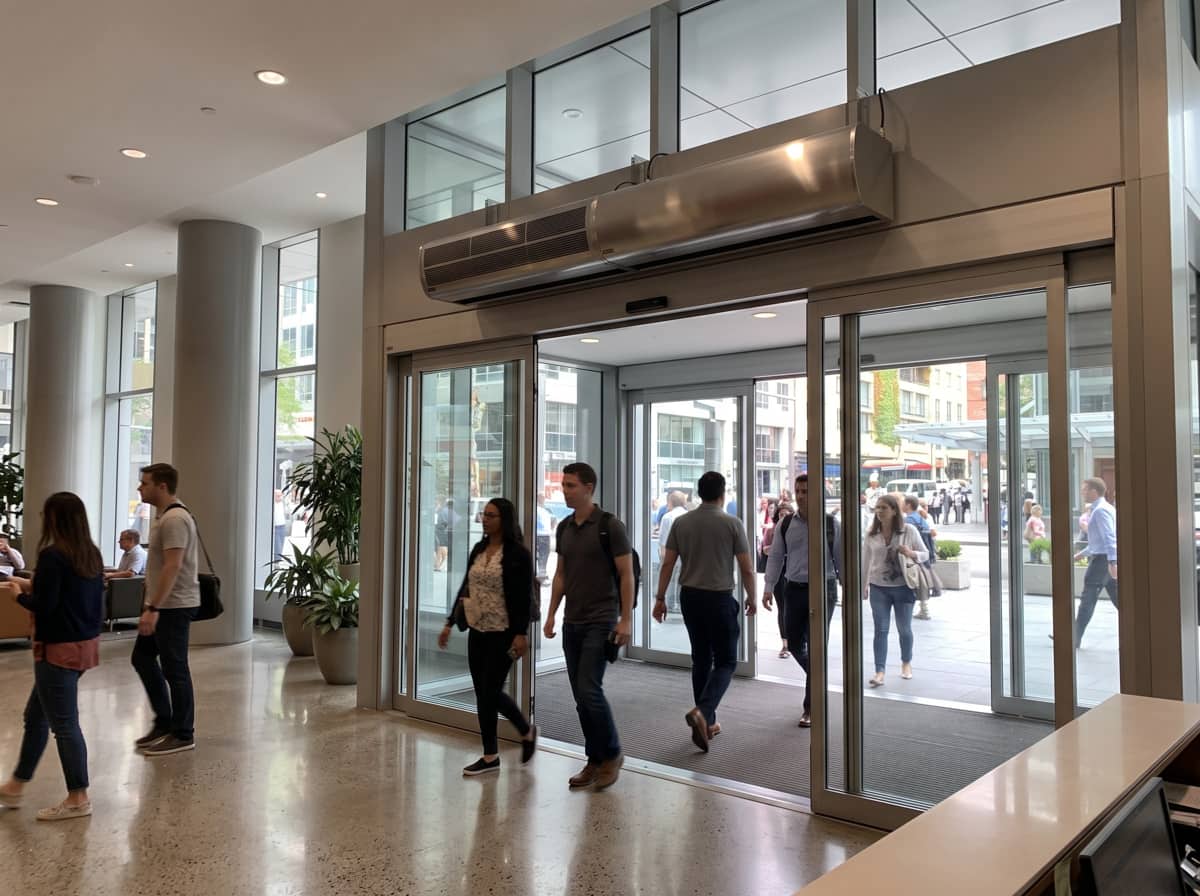
An air curtain is a fan unit mounted above a doorway. It blows a steady sheet of air across the opening, and that invisible barrier helps keep dust, flies and mosquitoes outside while the door stays open. It also slows the loss of cool air from your air-conditioned space.
If you run a restaurant on a busy Dhaka road, a factory loading bay in Gazipur or a hospital entrance in Chattogram, you already know the problem. The door opens a hundred times a day, and every time, dust, heat and a few flies walk in with your customers.
What Is an Air Curtain and How Does It Work?
To understand exactly how an air curtain works, it helps to look at its parts: it has a fan, a motor, a housing, an outlet (nozzle) that shapes the airflow, and a switch or controller. The fan pulls in air and pushes it out through the outlet as a fast, even stream aimed at the floor.
That stream works like an invisible wall. Air from outside hits it and is pushed aside instead of drifting through the doorway. People, trolleys and forklifts pass through without touching anything.
Main Types Used in Commercial Buildings
- Cross-flow air curtains: Quieter and compact. A good fit for shops, offices, clinics and restaurants with standard doors.
- Centrifugal air curtains: Stronger airflow. Better for tall doors, factory entrances, warehouses and loading bays.
- Recessed or surface-mounted: Recessed units hide inside the ceiling and look neat in lobbies and malls. Surface-mounted units are easier to install on existing buildings.
- Heated or unheated: Heated models are built for cold climates. In Bangladesh, an unheated unit is what you need almost every time.
How Air Curtains Reduce Dust at Commercial Entrances
Anyone working near a main road knows how fast a shop floor turns grey. Road dust, nearby construction, brick fields and heavy traffic keep fine particles in the air for most of the year, and the dry season makes it worse.
That dust settles on stock, machines, display counters and food which highlights the importance of understanding how air curtains help maintain clean rooms.
In a garment factory, it lands on fabric. In a pharmacy or showroom, it ruins the first impression. Staff end up cleaning the same surfaces again and again.
What the Air Barrier Actually Does
Dust travels on moving air. When your door is open, outside air flows in, and the dust comes with it. An air curtain cuts down that exchange, so far fewer particles are carried inside.
There is a second benefit if your space is air-conditioned. Less hot, humid air gets in, so your AC doesn’t have to fight as hard to hold the temperature. That matters in a country where cooling is one of the biggest electricity costs for any business.
Realistic Expectations
An air curtain reduces the dust that enters. It does not clean the air that is already inside. It is not a filter or an air purifier. For best results, combine it with entrance mats, regular floor cleaning and proper filtration where your work needs clean air.
How Air Curtains Keep Flies, Mosquitoes and Other Insects Out
Doors that open all day give insects plenty of chances. Food smells pull flies toward restaurants and sweet shops. Bright lights draw mosquitoes and moths in the evening. A fly only needs a few seconds to get in.
Fly screens and hanging strips don’t always fit busy entrances, because people and trolleys keep pushing through them.
Air Speed and Coverage Matter
Insects are light, and they avoid strong airflow. For an air curtain to keep them out, the air must stay fast enough all the way down to the floor and across the full width of the door. Many manufacturers quote about 6 to 8 metres per second at floor level for insect control. Always check the exact figure on the datasheet of the model you are buying, and ask how and where it was measured.
Two things cause most failures. The unit is narrower than the door, so there is a gap at the edge. Or it is mounted too high, so the airflow weakens before it reaches the ground.
Food-Area and Hygiene Notes
Air curtains are widely used at restaurant, bakery and kitchen entrances. Treat them as one layer of protection. They support pest control and food safety routines, but they do not replace cleaning schedules, waste handling or a licensed pest control service.
Where Air Curtains Make the Most Sense in Bangladesh
| Where | What it helps with |
| Restaurants, cafés, bakeries, food courts | Keeps flies and street dust away from the dining and food counter areas, and holds the AC cool when the door is always open. |
| Hospitals, clinics, diagnostic centres | Reduces dust and insects at general entrances and corridors. For critical areas like operation theatres, talk to your infection-control team first. |
| Pharmaceutical and food-processing units | Adds protection at material entry points and loading docks. It supports your hygiene controls, not replaces them. |
| RMG factories, warehouses, loading bays | Cuts dust on goods and machines, and makes life more comfortable for workers near large doors. |
| Supermarkets, malls, retail shops | Lets customers walk in freely without cool air pouring out onto the street. |
| Cold rooms and refrigerated storage | Reduces cold air loss when doors are opened often during loading. |
| Hotels, banks, office lobbies | Keeps the lobby cool and clean without closing a busy entrance. |
What Air Curtains Can’t Do
An honest supplier will tell you this before the sale, so here it is.
- Strong wind: A weak unit won’t hold against strong crosswinds or a big pressure difference between inside and outside. It needs correct sizing.
- Sealed spaces: An air curtain does not replace insect screens, sealed doors for sterile rooms, or HVAC filtration.
- Poor installation: A wrong mounting height or an undersized unit is the most common reason people feel an air curtain “doesn’t work.”
- Neglect: Dirty fans and blocked outlets weaken the airflow quickly, especially in dusty areas.
How to Choose the Right Air Curtain for Your Building
Select an air curtain that matches your doorway dimensions, installation height, and building requirements. Check its airflow capacity, energy consumption, noise level, durability, and maintenance needs before making a decision.
Key Specifications Checklist
Before you compare prices, compare these points on the datasheets:
- Door width and height. The unit should match the door width or be slightly wider. Taller doors need stronger airflow.
- Air outlet speed and airflow. Look for the speed in (m/s) and the volume in CFM or m³/h. Higher is not always better, but too low will fail.
- Motor and duty rating. If the unit runs all day, the motor should be rated for continuous use.
- Voltage compatibility. Bangladesh uses 220V at 50Hz, and voltage often fluctuates. Ask about tolerance, and consider a stabilizer.
- Noise level in dB. Important for restaurants, banks and offices.
- Housing material. Powder-coated steel is fine for most places. Stainless steel suits kitchens and humid areas.
- Controls. Speed settings, a door switch that turns the unit on only when the door opens, and a remote are all useful.
A rough guide to start the conversation (your supplier should confirm with a site check):
| Door size | Suggested unit | Typical use |
| Up to 1.0 m wide, standard height | Compact cross-flow, 900 mm | Small shops, pharmacies, kitchens |
| 1.5 m wide | Cross-flow, 1,500 mm | Restaurants, clinics, office entrances |
| 2.0–2.5 m wide | Cross-flow or centrifugal, 2,000–2,500 mm | Supermarkets, malls, hotel lobbies |
| 3.0 m and wider, or tall doors | Heavy-duty centrifugal, sometimes two units | Factories, warehouses, loading bays |
Installation and Maintenance Tips
Mount the unit above the door, level, and as close to the opening as possible. Where the manufacturer recommends it, angle the airflow slightly toward the outside. Make sure the unit covers the whole width of the door.
Connect it to a door sensor or switch so it only runs when needed. That saves electricity and extends motor life. Have a qualified electrician do the wiring, and make sure the wall or frame can carry the weight.
Routine Maintenance
In dusty places, clean the grille and fan once a month. Check the motor, bearings and mounting bolts regularly, and listen for new noise or vibration. Replace worn parts early. A small repair now is cheaper than a full motor replacement later.
Cost, Energy Use and Return on Investment
The price depends on size, motor type, housing material, brand, import duty, transport and installation. Two units that look alike can differ a lot in motor quality and airflow, so compare datasheets rather than just the number on the quotation.
The savings show up in different places: less AC loss through open doors, less time spent cleaning, and fewer complaints about flies and dust. As an illustration only: if a restaurant’s door stays open for most of the day and the AC works noticeably less with the curtain on, the saving on the monthly bill can add up over the year. Your numbers will depend on your door, your AC capacity and your electricity tariff.
Prices change with exchange rates and shipping costs, so ask for a current, site-specific quotation instead of relying on a number from a blog.
Buying Air Curtains in Bangladesh: What to Look For in a Supplier
Choose a trusted air curtain supplier in Bangladesh who shows full specifications, proper import documents and a real warranty. Check that spare parts are in stock locally, because a unit that waits weeks for a capacitor is no use to a busy shop. Good suppliers also offer technical advice before the sale and support after it.
Ask how long they have been in the business, and which projects they have supplied. A reliable company will give you clear answers and contact details without pressure.
Final Thoughts
An air curtain keeps your door open for business while holding back dust, insects and cool-air loss. It works best when it’s the right size, mounted at the right height and kept clean.
If you’re unsure what your entrance needs, contact our technical team with your door width, height, and use, and we’ll recommend a suitable model and share its datasheet.
Frequently Asked Questions
Do air curtains really stop flies and mosquitoes?
They greatly reduce how many get in when the unit is the right size and the air reaches the floor at enough speed. They don’t guarantee zero insects, so keep up normal pest control.
Can air curtains reduce AC electricity costs?
Often yes, because less hot air enters and less cool air escapes at busy doors. The saving depends on door size, traffic and AC capacity.
What size air curtain do I need for a 1.5 m or 2.5 m door?
Choose a unit equal to or slightly wider than the door: about 1,500 mm for a 1.5 m door and 2,500 mm for a 2.5 m door. Height and wind exposure may call for a stronger model.
Do air curtains work in dusty or windy areas?
They work in dusty areas, but need more frequent cleaning. In windy spots, you need a stronger centrifugal unit that is sized properly, and sometimes a wind break.
How often should an air curtain be serviced?
Clean it monthly in dusty places and every few months elsewhere. Have the motor and bearings checked at least once a year.