

How to Choose the Right Air Curtain for Your Factory or Warehouse

Operating a factory or warehouse in Bangladesh means constantly battling the elements. Between the sweltering summer heat, heavy monsoon humidity, and persistent dust, keeping your indoor environment stable is a massive challenge. Every time a large industrial door opens, you lose perfectly chilled air and invite in pests and pollution.
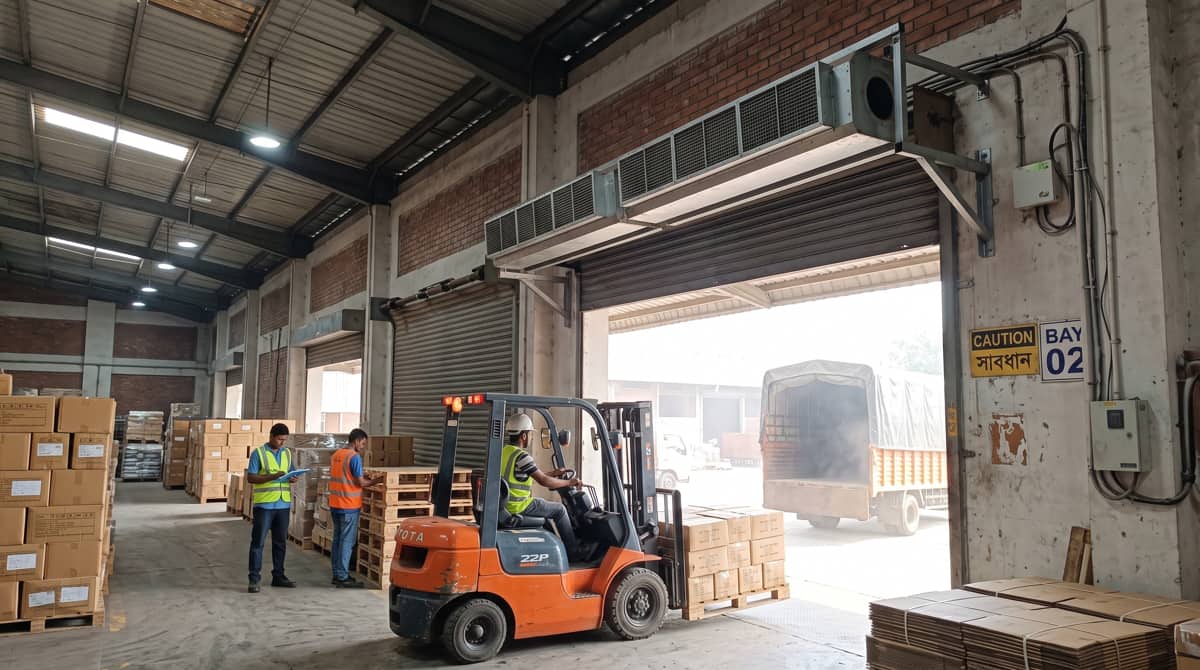
This is where an industrial air curtain often called an air door becomes essential. An air curtain is a powerful fan mounted above a doorway that blows a strong, continuous stream of air downward, creating an invisible shield.
As an importer of industrial equipment, I’ve visited countless local factories that are bleeding money simply because they installed the wrong size or capacity of air curtain. When you buy an undersized unit to save a few Taka, it fails to seal the door properly, forcing your air conditioners to work overtime.
Why Bangladeshi Industries Need Heavy-Duty Air Curtains
In the industrial sector, an open door is an expensive liability. Every minute your factory doors stay open for workers or forklifts, your cooling costs skyrocket. Heavy-duty industrial air doors solve this by acting as an invisible thermal barrier. By keeping the cool air inside and the hot, humid air outside, these units drastically improve the efficiency of your industrial air conditioning systems, directly lowering those massive monthly electricity bills.
But the benefits go far beyond just climate control. In Bangladesh, maintaining a clean workspace is critical for meeting strict international buyer compliance standards. Whether you are aiming for ACCORD/RMG safety approvals, ISO certifications, or BSTI standards, you must prove that your facility is a clean, hazard-free environment.
A properly installed air curtain actively blocks pest ingress, keeping flies, mosquitoes, and rodents out of your production lines. For specialized facilities like cold storage units, this invisible shield prevents ice buildup and product spoilage. Ultimately, investing in the right air curtain protects your bottom line, ensures your factory passes rigorous compliance audits, and creates a much more comfortable environment for your hardworking staff.
Types of Industrial Air Curtains Available in the Local Market
Before you buy, it is important to know that not all air curtains are built the same. Here are the three main types you will find in the Bangladeshi market:
Ambient (Unheated) Air Curtains
Ambient air curtains are the most widely used models in Bangladesh. Instead of heating or cooling the air, they simply take the existing room air and blow it downward at high speeds. These are perfect for standard manufacturing floors, packaging areas, and pedestrian doors where the main goal is blocking dust, preventing insect entry, and keeping the indoor air conditioning from escaping outside.
Heated Air Curtains
While less common in general manufacturing, heated air curtains are absolutely vital for specific applications, particularly in the food processing industry. These units feature built-in heating coils and are primarily used in deep-freeze cold storage transitions. When an extreme cold room opens into a warmer staging area, a heated air curtain prevents heavy condensation, dangerous ice build-up on the floors, and dense fog that can cause forklift accidents.
High-Velocity Heavy-Duty Air Curtains
When you are dealing with massive warehouse loading docks and constant heavy forklift traffic, a standard air curtain just won’t cut it. You need a high-velocity, heavy-duty air curtain. These are built with industrial-grade motors and massive fans designed to push a thick, powerful wall of air down from extreme heights, sometimes up to 20 feet or more. If you manage a bustling distribution center where bay doors are open all day, these rugged machines are the only way to effectively seal the massive openings against heavy winds, truck exhaust fumes, and outside heat.
5 Expert Criteria for Selecting the Right Air Curtain
Choosing the correct unit requires looking at the actual engineering of your space. Here are the five criteria you must consider:
1. Doorway Dimensions (Height and Width)
The most common mistake I see is buying an air curtain that exactly matches the door’s width. To create a true seal, your air curtain must be slightly wider than the doorway itself, usually overlapping by a few inches on each side so air doesn’t leak around the edges. Additionally, the maximum installation height is the ultimate deciding factor for motor power. If your door is 15 feet high but you buy a unit rated for only 10 feet, the air stream will break apart before it reaches the floor, leaving the bottom completely unprotected.
2. Air Velocity and CFM Ratings
You’ll often see the term CFM, which stands for Cubic Feet per Minute. This measures the volume of air the machine can push out. A higher CFM means a thicker, stronger air shield. A standard factory pedestrian door might only need a moderate CFM to keep flies out. However, a massive warehouse loading dock facing a dusty road requires a much higher CFM rating to push air aggressively all the way to the concrete floor and repel outside breezes. Always match the CFM to the scale of the doorway.
3. Dealing with Bangladesh’s Wind and Humidity
Here is a reality many foreign brochures ignore: the “monsoon factor.” During Bangladesh’s rainy season, factories are hit with heavy external wind loads and extreme humidity. A basic air curtain will just get blown inward by a strong gust of wind. To combat this, you need a unit with strong, adjustable louvers (the metal fins that direct the air). By angling the louvers slightly outward against the incoming wind, you can maintain a perfect seal even during a monsoon storm. Furthermore, stronger motors are necessary here to fight off the heavy, moisture-dense coastal air.
4. Noise Levels (Decibels/dB)
While you want a powerful motor, you also have to consider the factory environment. High-velocity fans can be incredibly loud. If an air curtain is installed over a door where workers stand all day, a high decibel (dB) rating can cause fatigue, disrupt communication, and violate workplace safety standards. Always check the dB rating and try to strike a balance between necessary air power and a tolerable noise level for your specific floor staff.
5. Power Supply and Motor Durability
Industrial zones in places like Gazipur, Narayanganj, and Chittagong are notorious for severe voltage fluctuations. A cheap, standard motor will quickly burn out under these unstable power conditions. When selecting an air curtain for a local factory, always prioritize units built with heavy-duty, thermally protected motors. Look for machines that can comfortably handle the realities of our local power grid without requiring constant repairs or expensive replacement parts just a few months down the line.
Industry-Specific Applications in Bangladesh
Different industries face totally different challenges. Here is how air curtains protect the most vital sectors in our country:
Garments and Textile (RMG)
The Ready-Made Garments (RMG) sector requires precise environmental control. In spinning mills, raw cotton creates massive amounts of airborne lint and dust. Air curtains are essential here to prevent this dust from drifting into sensitive machinery rooms. On the sewing floors, keeping the space cool directly boosts worker productivity and reduces heat fatigue. By placing air curtains at the main entrances, RMG factory owners can keep their central air conditioning locked inside, creating a vastly better working environment while easily passing crucial buyer compliance audits.
Pharmaceuticals and Cleanrooms
Pharmaceutical manufacturing leaves absolutely zero room for error. Strict hygiene is mandatory, and facilities must comply with strict DGDA and FDA regulations. Every time a cleanroom entrance opens, there is a severe risk of airborne contaminants, dust, and microbes flooding in. Specialized, highly calibrated air curtains act as an impenetrable barrier, maintaining the sterile integrity of the lab or production line. For pharma companies, an air curtain is a critical piece of hygiene infrastructure that prevents catastrophic batch contamination.
Food Processing and Cold Storage
In the food processing sector, preserving the cold chain is a matter of business survival. When loading and unloading goods, giant cold room doors must remain open, inviting in the hot, humid Bangladeshi air. This causes massive temperature drops and dangerous condensation. High-efficiency air curtains designed for cold storage prevent this hot air from entering the deep-freeze zones. By maintaining sub-zero temperatures reliably, factory owners prevent their cooling compressors from overloading, drastically cut down on electricity usage, and ensure perishable goods stay fresh and safe.
Pricing of Industrial Air Curtains in BD
When comparing air curtain suppliers across Bangladesh, it is important to look beyond the initial purchase price and consider long-term operating costs. Heavy-duty industrial air curtains in Bangladesh generally cost between BDT 25,000 and BDT 85,000 or more per unit, depending on the door size, motor capacity, and country of origin. Budget-friendly models from China often fall at the lower end of the price range, while premium models from Taiwan or Europe may cost more due to their motor durability and energy efficiency. Before choosing a supplier, compare product specifications, installation costs, warranty coverage, and after-sales support to ensure the air curtain meets your building’s requirements.
However, the real financial conversation is about Return on Investment (ROI). Buying an air curtain is a business investment, not just a hardware expense. Because a properly sized air door prevents your heavy HVAC systems from overworking, you will see an immediate drop in your monthly factory electricity bills. For most industrial facilities in Bangladesh, an air curtain can help reduce energy waste and operating costs. Learn more about how air curtains save energy and their potential return on investment. After that break-even point, the machine is essentially saving you money every single day it operates.
Best Practices for Installation and Maintenance
Even the best equipment will fail if it’s installed poorly. Always use heavy-duty mounting hardware to secure the unit tightly against the wall to prevent rattling and vibrations. I highly recommend requesting a micro-switch installation; this brilliant feature automatically turns the air curtain on the second the door opens and shuts it off when the door closes, saving even more power. For routine maintenance, factory staff must regularly wipe down the intake grills to prevent industrial lint and dust from choking the fans. While preventive care solves most issues, knowing how to resolve air curtain problems and solutions quickly will ensure your doorways stay protected year-round. Finally, schedule bi-annual checks for the motors to keep them running smoothly for years.
Partnering with a Reliable Equipment Supplier
Ultimately, buying an industrial air curtain is an engineering decision, not a simple hardware purchase off a shelf. Getting the height, width, and CFM capacity wrong will leave your factory vulnerable to the heat, dust, and insects you are trying to keep out.
You need equipment that is uniquely matched to your specific operational needs and the harsh realities of our local climate. Don’t guess with your facility’s efficiency. Reach out to the engineering team at Seraphic Associate today with your doorway dimensions and industry type for a customized consultation, a proper technical quote, and lasting peace of mind.