

How to Choose the Right Industrial Air Cooler in Bangladesh: Complete Buyer’s Guide

An industrial evaporative air cooler lowers indoor temperatures by 5°C to 10°C using water evaporation and high-volume fresh air, consuming up to 80% less electricity than traditional air conditioning. For open and semi-open spaces in Bangladesh such as RMG factories, textile mills, and large warehouses standard HVAC chillers trap stale air and drive up utility bills.
Bangladeshi factory owners face a tough balancing act every summer. On one side, BPDB, DESCO, and REB commercial electricity tariffs continue to climb. On the other, international buyers and regulatory bodies like the RSC (formerly Accord) and Nirapon enforce strict workplace heat-stress standards. Choosing the right evaporative cooling system solves both problems, delivering continuous fresh air and massive BDT cost savings without overloading your substation.
How Industrial Evaporative Air Coolers Work in Bangladesh’s Climate
Industrial evaporative cooling systems in Bangladesh work on a simple natural principle: warm outside air is pulled through water-soaked honeycomb pads, where the water absorbs heat from the air and evaporates. A powerful fan then pushes this cooled, fresh air directly onto the factory floor while pushing hot, stagnant indoor air out through windows or exhaust fans.
Managing Dry Heat vs High Monsoon Humidity
The biggest question factory owners in Bangladesh ask is: “Do air coolers actually work during the humid monsoon?”
During the dry heat of March to May, evaporative cooling drops indoor temperatures by 7°C to 10°C. When monsoon humidity hits 80%+ between June and September, pure water evaporation slows down. In our field installations across Gazipur and Chattogram, we solve this by pairing roof-mounted positive-pressure air coolers with Negative Pressure Exhaust Fans on the opposite wall.
On ultra-humid days, you can switch off the cooler’s water pump and run the fan dry alongside the exhaust system. This creates a high-velocity wind-chill effect and exchanges the entire room’s air 30 to 45 times per hour sweeping away machine heat, steam, and indoor stuffiness immediately.
Industrial Air Cooler vs. Chiller HVAC vs. Exhaust Fans
| Feature | Industrial Air Cooler | Central Chiller HVAC | Industrial Exhaust Fan |
| Initial Capital Cost (BDT) | Low (৳65,000 – ৳1,80,000 per unit) | Very High (Crores of BDT for large floors) | Very Low (৳18,000 – ৳35,000 per unit) |
| Monthly Power Usage (kW) | 1.1 kW – 3.0 kW per 1,500 sq. ft. | 15 kW – 25 kW per 1,500 sq. ft. | 0.75 kW – 1.1 kW per unit |
| Maintenance Complexity | Simple (Monthly pad & tank wash) | Complex (Requires HVAC engineers & gas) | Minimal (Belt & shutter cleaning) |
| Best Application | RMG floors, textiles, warehouses, poultry | Sealed corporate offices, cleanrooms | Extracting hot air (Does not cool air) |
Step-by-Step Sizing Guide: Calculating CFM & Cooling Capacity
Buying coolers based on guesswork leads to two expensive problems: buying too few units leaves workers sweating, while buying oversized units wastes capital and electricity. Site engineers calculate the exact airflow needed in CFM (Cubic Feet per Minute) based on room volume and heat load.
The Exact CFM Formula for Bangladeshi Factories
To find out how much airflow your floor requires, use this standard engineering formula:
TotalCFM=FloorArea(Sq.Ft.)*CeilingHeight(Ft.)*AirChangesPerHour(ACH) / 60
Real-World Example (Gazipur Garment Sewing Floor):
Imagine you manage a 10,000 sq. ft. sewing floor in Gazipur with a 12 ft. ceiling height, packed with 300 sewing machines and operators. Because of body heat and motor heat, an RMG sewing floor needs 30 Air Changes Per Hour (ACH).
- Room Volume: 10,00012=120,000cubicfeet
- Total CFM Required: (120,00030)60=60,000CFM
- Number of Coolers: If you choose standard 18,000 CFM industrial coolers, divide 60,00018,000=3.33. Installing 4 units of 18,000 CFM coolers (with proper GI ducting) will keep that floor comfortably cool.
Recommended Air Changes Per Hour (ACH) by Industry
Different industries generate different levels of indoor heat, dust, and fumes. Use these local benchmarks when calculating your CFM:
- RMG Sewing & Finishing Floors (25–35 ACH): Accounts for dense worker seating, continuous sewing motor heat, and steam iron tables.
- Textile Spinning, Knitting & Dyeing Units (40–60 ACH): High-speed machinery and dyeing vats generate intense radiant heat that requires rapid air replacement.
- Poultry Farms & Agro-Processing Sheds (30–45 ACH): Prevents heat stroke in broilers and layers while flushing out toxic ammonia buildup from litter.
- FMCG & Pharmaceutical Packaging Warehouses (15–25 ACH): Fewer workers and lower machine heat mean gentle, steady air circulation is enough to protect stored goods under hot tin roofs.
Types of Industrial Air Coolers Available in the Bangladesh Market
Choosing from the different types of industrial air coolers depends on your building structure whether you operate out of a multi-story RCC building or a single-story pre-fabricated steel shed.
Fixed Ducted Air Coolers (Roof, Wall, & Window Mounted)
Fixed coolers are installed outside the building and push cool air inside through galvanized iron (GI) or PP ducts. They come in three discharge designs:
- Bottom Discharge (Down-Draft): The air outlet sits at the bottom of the unit. This is the safest and most popular choice for tin-shed and steel-structure roofs because it requires minimal external ductwork and puts less wind load on the roof sheets.
- Side Discharge: The air outlet sits on the side. This works best for multi-story RCC factory buildings (common in Dhaka EPZ, Chattogram EPZ, and Narayanganj), where the cooler mounts on the exterior wall using heavy-duty MS angle brackets and ducts straight through a window opening.
- Top Discharge (Up-Draft): Mounted on the ground or a low platform outside, pushing air upward into an elevated wall entry. Ideal when walls cannot bear weight and roof mounting isn’t possible.
Portable Heavy-Duty Industrial Air Coolers
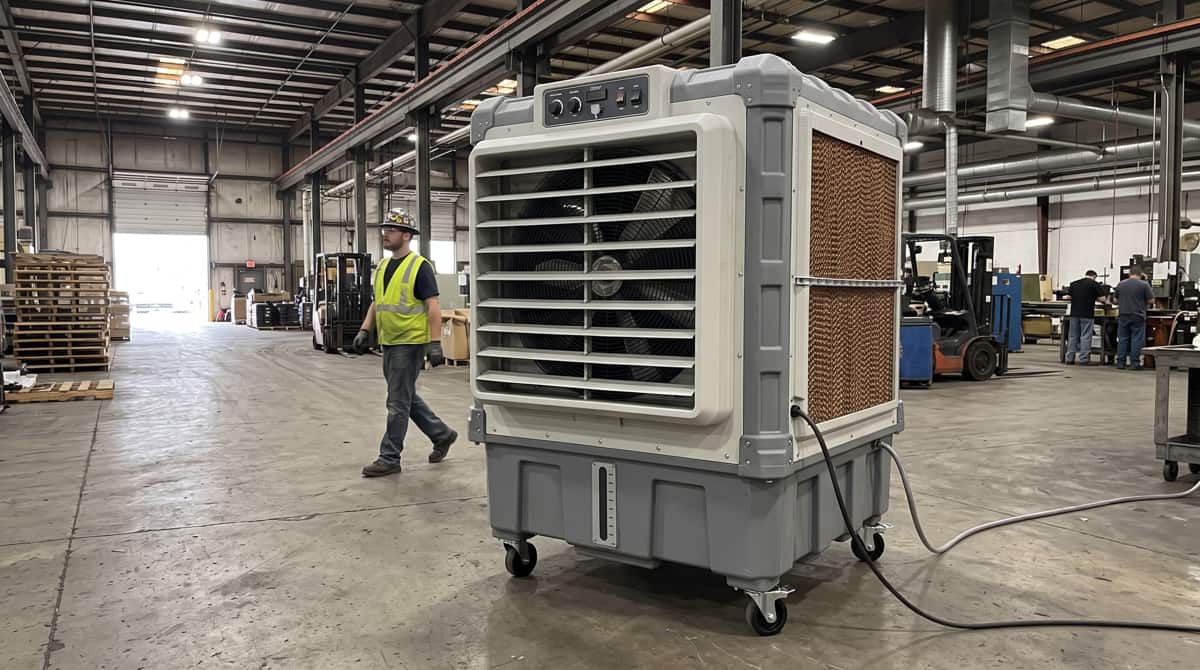
Not every workspace can accommodate permanent overhead ducting. Portable industrial air coolers sit on heavy-duty lockable caster wheels and plug into a standard single-phase socket.
- Best Use Cases: Spot cooling for high-heat zones like welding bays, boiler and generator rooms, loading docks, garment sample rooms, and temporary construction sites.
- Water Supply Options: These units feature large built-in water reservoirs ranging from 100L to 200L for 8 to 12 hours of continuous operation. For permanent stations, always pick a model equipped with a continuous auto-water-inlet float valve so you can connect a garden hose or PVC water line directly and never worry about workers forgetting to refill the tank.
Critical Technical Specifications to Inspect Before Importing or Buying
Many local traders import low-cost, thin-plastic units meant for small shops and sell them as “industrial grade.” Within a year, the motors burn out and the pads collapse. Before issuing a work order or opening an LC, verify these six specifications.
1. Honeycomb Cooling Pad Density & Thickness (5090 vs. 7090 Flute)
Insist on 100mm thick 5090 or 7090 flute virgin kraft paper evaporative cooling pads treated with anti-rot resin. Bangladeshi air especially near dusty industrial highways in Savar, Gazipur, and Sitakunda clogs cheap recycled paper pads within months, causing foul smells and soggy collapses.
2. Motor Quality: 100% Copper Winding & IP54/IP55 Waterproof Rating
Voltage drops and phase imbalances are an everyday reality in industrial areas like Ashulia, Bhaluka, and Rupganj. Avoid aluminum-wound motors, which overheat and short-circuit under fluctuating loads. Always specify a Three-Phase (380V–415V, 50Hz), 100% copper-wound motor with an IP54 or IP55 rating. This seals the motor against monsoon rain, high humidity, and textile lint.
3. Cabinet Material: UV-Stabilized Virgin PP Engineering Plastic vs. GI Sheet
Outdoor coolers bake under 40°C summer sun and get battered by heavy monsoon rains. Cheap recycled plastic cabinets turn brittle and crack within two summers, while local GI sheet bodies rust through. Ensure the body is injection-molded from UV-stabilized Virgin Polypropylene (PP) copolymer, which resists corrosion, chemical fumes, and direct sunlight for over 10 years.
4. Auto-Drain & Pre-Filter Dust Screens
Groundwater from WASA lines or factory submersible borewells across Bangladesh is notorious for high iron content and hardness. Without an automatic electric drain valve, mineral-heavy water sits in the basin, forming hard white scale that ruins the water pump and pads. Combine an auto-drain cycle (which flushes dirty water every 4–8 hours) with external nylon pre-filter dust nets to block yarn fibers and road dust.
Industrial Air Cooler Price in Bangladesh & 3-Year ROI Breakdown
When presenting a cooling proposal to your board or finance team, looking only at unit price is misleading. You need the complete landed and installed cost alongside the monthly utility savings.
Current Market Price Ranges by Capacity
Prices in Bangladesh vary based on motor type (single-speed vs. inverter), cabinet thickness, and how many feet of GI ducting your floor layout requires:
| Airflow Capacity | Motor Power | Unit Price Range (BDT) | Est. Ducting, Stand & Installation (BDT) | Ideal Coverage Area |
| 18,000 – 20,000 CFM | 1.1 kW – 1.5 kW | ৳65,000 – ৳90,000 | ৳25,000 – ৳45,000 per unit | 1,200 – 1,500 sq. ft. |
| 25,000 – 30,000 CFM | 2.2 kW – 3.0 kW | ৳1,05,000 – ৳1,45,000 | ৳35,000 – ৳60,000 per unit | 1,800 – 2,500 sq. ft. |
| 40,000 – 50,000 CFM | 4.0 kW – 5.5 kW | ৳1,65,000 – ৳2,30,000 | ৳50,000 – ৳85,000 per unit | 3,000 – 4,000 sq. ft. |
Electricity Bill Calculation & Payback Period
Let’s compare the real operating cost of cooling a 12,000 sq. ft. factory floor for 10 hours a day, 26 days a month, using an average commercial electricity tariff of ৳11.50 per kWh (unit):
- Option A: 50-Ton Central Chiller HVAC
- Power consumption: ~65 kW per hour
- Monthly usage: 65kW10hrs26days=16,900kWh
- Monthly Electricity Bill: ৳1,94,350
- Option B: Ten 18,000 CFM Industrial Air Coolers
- Power consumption: 1.1kW10units=11kWperhour
- Monthly usage: 11kW10hrs26days=2,860kWh
- Monthly Electricity Bill: ৳32,890
The ROI Math: You save ৳1,61,460 every single month on electricity alone. Even with a total project cost of around ৳10,50,000 (10 coolers + full GI ducting and electrical setup), the entire system pays for itself in under 7 to 9 operating months. Over a 3-year period, your factory retains over ৳45 Lakh in pure operational cash flow.
Workplace Safety, Compliance & Maintenance
Installing industrial cooling is not just an operational upgrade; it directly impacts worker health, fire safety, and structural integrity.
Meeting Accord/RSC, ILO, and Bangladesh Labour Act Heat Stress Standards
Under the Bangladesh Labour Act and international buyer audit frameworks (RSC, Nirapon, Sedex, and WRAP), factories must maintain adequate ventilation and safe thermal conditions. When indoor floor temperatures climb past 34°C, worker efficiency drops by 20% to 30%, mistake rates rise, and heat exhaustion incidents spike. Keeping the working zone between 26°C and 28°C with fresh oxygenated air boosts daily production output and guarantees smooth compliance audits.
Structural Load Safety & Electrical Earthing
An 18,000 CFM cooler filled with 40 liters of water weighs around 85 kg to 100 kg.
- Bracket Safety: Wall-mounted units must use heavy-gauge hot-dip galvanized or red-oxide painted MS angle brackets anchored with through-wall bolts—never rely on standard rawl plugs in brick walls.
- Roof Waterproofing: For rooftop installations, seal all duct penetrations with industrial bitumen flashing tape and silicone sealant so monsoon storms don’t leak onto expensive machinery below.
- Electrical Protection: Every unit must connect to your factory’s main earthing grid and have a dedicated MCB/MCCB circuit breaker inside a waterproof distribution box to eliminate electrical fire risks.
Preventing Legionella, Mold, and Iron Scaling from Submersible Water
Stagnant borehole water mixed with factory dust can breed mold, algae, and waterborne bacteria. Assign your utility maintenance team a simple 3-step monthly routine:
- Shut off power, drain the bottom pan completely, and brush out reddish iron sludge.
- Rinse the external dust screens and flush the honeycomb pads with low-pressure clean water (never use high-pressure jet washers, which tear the paper flutes).
- At the end of October, drain the tanks dry, run the fan without water for 30 minutes to dry the pads completely, and cover the unit for winter.
How to Get an Industrial Air Cooler Importer & Supplier in Bangladesh
Many suppliers in local markets operate as middlemen without technical teams or spare parts, which is why partnering with an established industrial solutions provider like Seraphic Associate. If a water pump or control board fails in the middle of May, waiting three weeks for parts will halt your production line. Vet your supplier against this checklist before signing a contract:
- Verify Direct Import Documents: Ask to see their IRC (Import Registration Certificate), the manufacturer’s Certificate of Origin (whether sourced from top-tier plants in China, Malaysia, Australia, or India), and recent Bills of Entry. Direct importers offer real factory warranties and honest pricing without broker markups.
- Check In-House Duct Fabrication & CAD Capability: A cooler is only as effective as its ductwork. Poorly designed ducts leak air and make loud whistling noises. Ensure your supplier has their own GI/PP duct fabrication workshop and provides a proper AutoCAD airflow layout showing exact grill placements before installation begins.
- Confirm Readily Available Local Spare Parts: Visit or verify their warehouse stock in Dhaka or Chattogram. Make sure they keep submersible water pumps, automatic float valves, drain valves, LCD wall controllers, PCB motherboards, fan blades, and replacement 5090 pads in ready stock for immediate 24-hour service support.
Conclusion & Requesting an On-Site Factory Cooling Assessment
Choosing the right industrial air cooler comes down to three fundamentals: calculating the exact CFM and air changes for your heat load, insisting on virgin PP cabinets with copper motors and 100mm 5090 pads, and pairing your coolers with exhaust fans to handle Bangladesh’s humid monsoon months.
Don’t leave your factory’s cooling budget to guesswork. Contact our engineering team today to schedule a free on-site thermal load inspection. Our surveyors will measure your floor, calculate your exact CFM requirements, and provide a custom AutoCAD ducting layout and transparent BDT rate tailored to your facility.
Frequently Asked Questions (FAQs)
How much area can an 18,000 CFM industrial air cooler cover in Bangladesh?
A single 18,000 CFM industrial air cooler covers 1,000 to 1,500 sq. ft. in a standard warehouse or assembly hall. In high-heat zones like garment ironing sections, knitting floors, or crowded sewing lines, plan for 800 to 1,100 sq. ft. per unit to maintain a comfortable 26°C–28°C temperature.
Can industrial air coolers reduce humidity inside a textile or garment factory?
Evaporative coolers add moisture when cooling dry air, so they do not dehumidify on their own. However, during humid monsoon days, running the coolers on fan-only ventilation mode paired with opposite-wall negative pressure exhaust fans flushes out trapped indoor humidity, steam, and body heat within minutes.
How often do honeycomb cooling pads need replacement in Bangladeshi water conditions?
High-density 100mm 5090 virgin kraft paper cooling pads last 3 to 5 years in Bangladesh if you use an automatic drain valve and wash away iron sediment monthly. If your factory uses untreated high-iron submersible water without regular draining, mineral scaling will harden the pads in 18 to 24 months.