

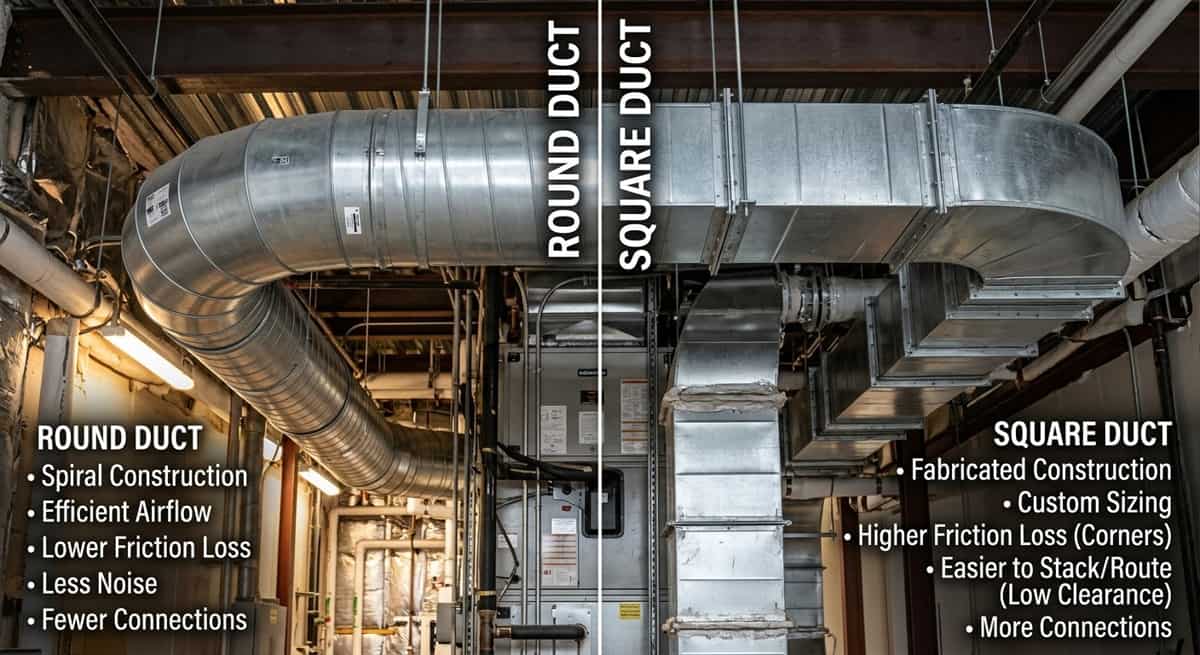
Round Duct vs Square Duct: Which Is Better Systems in Bangladesh?

Imagine you’re setting up a new RMG unit in Gazipur or Savar, and your contractor asks one simple question: “Round duct na square duct?” It sounds like a small decision, but it isn’t. The ductwork you choose today will affect your electricity bill, your maintenance headaches, and even how much usable ceiling space you have for the next 15 to 20 years.
Round ducts and square ducts both move air, but they don’t do it the same way, and they don’t fit every building the same way either. One might save you money on power. The other might be the only one that actually fits above your machines. There’s no single “better” option here; it depends on your space, your budget, your building type, and what your local fabricator can realistically build well.
What Are Round and Square (Rectangular) Ducts?
Ducts are simply the pathways usually made from GI (galvanized iron) sheets that carry air from your fan or AHU to different parts of a building. In Bangladesh, you’ll see both shapes used everywhere from RMG factories and warehouses to shopping malls and office buildings. The right shape depends less on what looks standard and more on how the space is built and what the air needs to do once it gets there.
Round Duct Basics
Round ducts cylindrical pipes, often made from spiral-formed GI sheets. Air moves through them smoothly because there are no sharp corners to slow it down. They’re common in facilities where ceiling height isn’t a problem and energy efficiency matters like large warehouses, food processing units, and modern factory floors designed with duct routing in mind from day one.
Square/Rectangular Duct Basics
Square or rectangular ducts are built flat-sided, usually fabricated on-site by local sheet metal workers. They’re the more familiar option in Bangladesh simply because most fabrication shops are set up to build them quickly and cheaply. They tend to fit into tight, low-ceiling spaces better, which is a big reason they’re still the default choice in many older or space-constrained buildings.
Airflow Efficiency: Which Moves Air Better?
Here’s the physics in plain terms: air likes curves, not corners. As air travels through a duct, it rubs against the internal surface, and every corner or flat edge creates extra resistance engineers call this friction loss. Round ducts have a smooth, continuous internal surface, so air glides through with far less resistance. Square ducts have four corners where airflow slows down and turns turbulent.
What does that mean for you in practical terms? Your fan or AHU has to work harder to push the same amount of air through a square duct compared to a round one. In a country where electricity costs keep climbing and load-shedding already puts pressure on backup generators, that extra fan effort adds up fast both in your monthly power bill and in wear on your equipment. Round ducts also tend to run quieter, which matters if the ductwork passes near office space or a floor where workers need to concentrate.
Space and Installation Fit in Bangladeshi Buildings
This is usually the deciding factor on the ground, more than airflow efficiency or even cost. Most RMG factories, older commercial buildings, and warehouses in Bangladesh weren’t built with generous ceiling voids in mind; false ceilings are often shallow, and the space above them is shared with sprinkler pipes, electrical trays, and structural beams.
When Square Ducts Win on Space
For the same airflow capacity, a rectangular duct can be built flatter and wider so it slides into a shallow ceiling gap where a round duct simply wouldn’t fit. If your building has low floor-to-floor height (common in many multi-story RMG factories), square ducts are often the only realistic option without expensive structural changes.
When Round Ducts Are the Better Fit
If you’re building a new warehouse, a modern factory shed, or a facility with double-height ceilings, round ducts become a strong option. With more vertical space to work with, you get all the airflow and energy benefits of round ducts without fighting for ceiling room. Many newer industrial parks and export-oriented factories are now designing ceiling height specifically to allow this.
Material, Fabrication & Cost in the Local Market
Cost isn’t just about the duct itself, it’s about what’s easy to build well in Bangladesh, and what has to be brought in from outside.
Local Fabrication Availability
Walk into almost any sheet metal workshop in Dhaka, Chattogram, or Gazipur, and you’ll find rectangular duct fabrication is their bread and butter. It’s a skill that’s been passed down and practiced for decades locally, which means faster turnaround, easier repairs, and workers who already know how to get the joints right. Round duct fabrication, especially proper spiral ducting is far less common locally, and quality can vary a lot between shops.
Import vs Locally Fabricated Round Ducts
Because good spiral round ducting machinery isn’t widely available here, many suppliers import pre-fabricated round ducts, particularly for larger commercial and industrial projects. This gets you factory-grade quality and consistent joints, but it adds lead time (often several weeks) and import cost, plus the usual customs and logistics considerations. If your project timeline is tight, this is worth planning for early, not something to sort out after your fabrication schedule is already set.
Rough Cost Comparison (Per Sq. Ft or Running Ft)
As a general rule, locally fabricated square ducts cost less upfront per running foot, simply because labor and material sourcing are straightforward and competitive. Round ducts, especially imported ones usually cost more initially. But when you factor in the lower fan energy consumption of round ducts over years of operation, the total cost picture can shift, sometimes significantly, especially for systems that run long hours like RMG factories.
Durability in Bangladesh’s Climate
Bangladesh’s humidity, dust, and monsoon season are hard on any metal ductwork, but the shape of the duct affects how well it holds up over time. Round ducts, particularly spiral-formed ones, have fewer joints and seams overall, which means fewer weak points where moisture, dust, or rust can creep in. Square ducts have more corners and seams by design, and if the fabrication quality isn’t consistent which can happen with rushed local jobs those seams can loosen or corrode faster, especially in coastal or high-humidity areas.
That doesn’t mean square ducts are automatically less durable. A well-fabricated rectangular duct with proper sealing and good-gauge GI sheet can last just as long. But it does mean the quality of your local fabricator matters more with square ducts than it does with factory-made round ones.
Noise, Leakage & Maintenance
Every joint in a duct is a potential leak point, and leaks mean you’re paying to cool or ventilate air that never actually reaches where it’s needed. Round ducts generally have fewer joints and a tighter seal by design, so they leak less air and run quieter; you’ll notice this especially in facilities where duct runs pass near work areas.
Square ducts, on the other hand, are genuinely easier to access and clean. Their flat sides make it simpler for maintenance staff to open access panels, inspect for dust buildup, or patch a section without special tools. In a factory environment where regular cleaning matters for both air quality and fire safety, that ease of access is a real, practical advantage not just a minor convenience.
Which One Should You Choose? A Decision Framework
Instead of chasing a single “winner,” ask yourself these four questions:
How much ceiling height do you actually have? If your false ceiling void is shallow, square ducts are usually the practical choice regardless of their other trade-offs.
Are you building new or retrofitting? New builds give you the freedom to plan for round ducts from the start. Retrofits into existing low-clearance buildings usually lean square.
What matters more to you lower upfront cost or lower running cost? If your budget is tight right now, square ducts win. If your facility runs long hours and energy cost adds up over years, round ducts may pay for themselves.
What type of facility is this? RMG factories with dense machine floors and tight ceiling space often lean square. Large warehouses, food processing units, or newly designed industrial sheds with taller ceilings often lean round.
In practice, many Bangladeshi industrial facilities don’t pick just one. A common and sensible approach is a hybrid system round ducts for the main trunk lines where airflow efficiency matters most, and square branch ducts for the tighter runs closer to machines and workstations. This gives you efficiency where it counts and flexibility where space is limited.
Industrial Equipment Buying Checklist for Bangladeshi Facilities
Before you sign off on any ductwork order imported or locally fabricated get clear answers on these points:
- Sheet gauge thickness: Thinner gauge might be cheaper, but it dents easily and corrodes faster. Ask exactly what gauge is being quoted.
- Insulation class: If your ducts run through unconditioned space, confirm whether insulation is included and what type.
- Joint and seam quality: For square ducts especially, ask how joints will be sealed. Poor sealing is where most long-term leaks start.
- Lead time in writing: For imported round ducts, get a firm delivery timeline in the contract, not a verbal estimate.
- After-sales support: Confirm who handles repairs or modifications after installation; this matters more than the initial price in the long run.
Asking these questions upfront saves you from expensive surprises six months into using the system.
Conclusion & Next Step
There’s no universal answer to round versus square ductwork and honestly, anyone who tells you there is hasn’t looked closely at your building. The right choice comes down to your ceiling space, your budget stage, your building type, and how well your local fabricator can execute the job. For many Bangladeshi facilities, the smartest answer isn’t choosing one over the other, it’s using both, strategically, in a hybrid system.
If you’re planning ductwork for a new facility or upgrading an existing one, getting this decision right from the start saves you money and headaches for years to come. Contact Seraphic Associate for a site assessment, and our technical team will help you design the exact system that fits your space, your budget, and your operational needs.
Frequently Asked Questions
Which duct type is cheaper in Bangladesh?
Locally fabricated square ducts are usually cheaper upfront because labor and materials are easy to source locally. Round ducts, especially imported ones, cost more initially but can save money over time through lower energy use.
Can round and square ducts be combined in one system?
Yes, and it’s common practice. Many facilities use round ducts for main trunk lines to maximize airflow efficiency, then switch to square branch ducts for tighter spaces near machines or workstations.
Which duct type is better for RMG factories specifically?
It depends on the ceiling height. Most RMG factories have limited ceiling void, so square ducts are often more practical. Newer factories built with taller ceilings can consider round ducts for main lines.
Do round ducts really save more electricity?
Yes, generally. Their smooth interior reduces airflow resistance, so fans use less energy to move the same volume of air compared to square ducts, which have more turbulence at the corners.
How long do GI ducts last in Bangladesh’s climate?
With good gauge thickness and proper sealing, GI ductwork can last 15-20 years even in humid conditions. Poor fabrication quality or thin gauge sheet can cut that lifespan significantly, especially in coastal or high-moisture areas.
Where can I source industrial ducting equipment in Bangladesh?
You can work with local fabrication shops for square ducts, or with specialized suppliers who import pre-fabricated round or spiral ducting for larger commercial and industrial projects.