

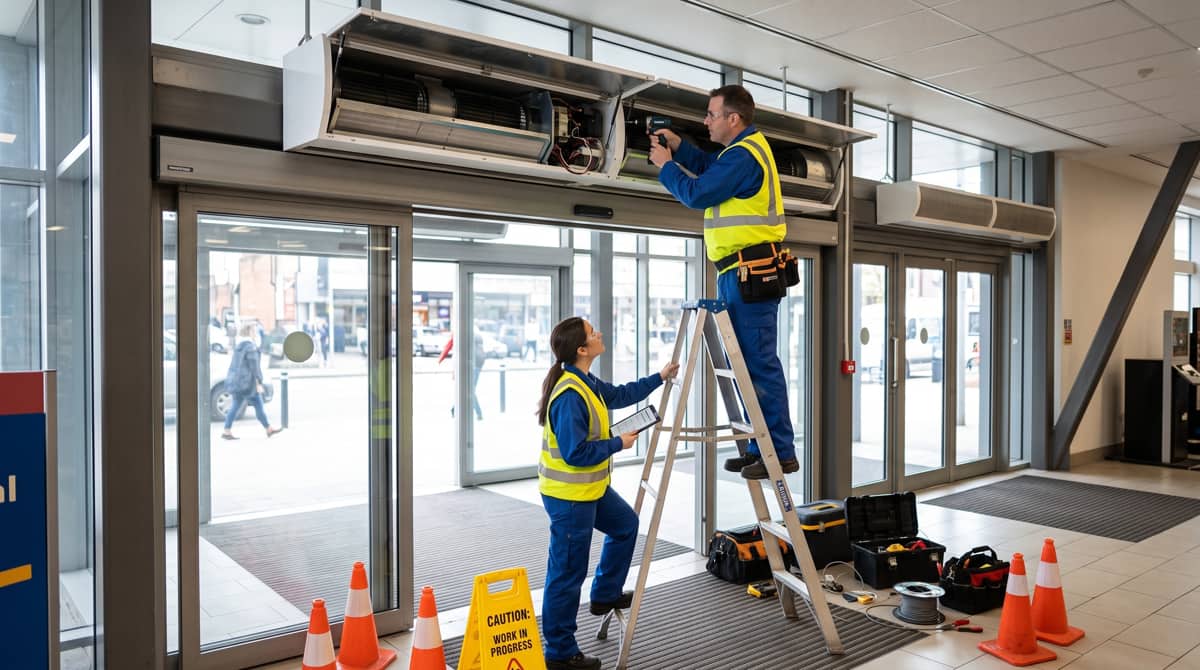
How to Install and Maintain an Air Curtain in Bangladesh

A busy garments factory in Gazipur or a bustling cold storage facility in Chittagong. Every time the loading dock doors open, expensive chilled air rushes out, and heavy outside heat pours in. You are losing cooling efficiency by the second. Worse, those open doors invite in thick dust and high monsoon humidity, directly threatening your product quality and skyrocketing your energy bills.
This is exactly where an industrial air curtain steps in to save your bottom line. As essential industrial equipment, it acts as an invisible barrier of fast-moving air, separating the indoor and outdoor environments without blocking foot traffic or forklifts. Proper energy efficiency in your facility depends on it.
Why Bangladesh’s Climate Makes Air Curtains Essential
Operating an industrial facility in Bangladesh means battling the elements year-round. If you run a plant in Narayanganj or Savar, you already know the toll heavy airborne dust takes on your machinery and cleanrooms. Air curtains act as an impenetrable invisible shield, forcefully blowing down a wall of air that stops road dust, vehicle exhaust, and flying insects from crossing your threshold.
Then comes the rainy season. During the monsoon, cross-ventilation brings in severe humidity. If damp air floods into your manufacturing floor or warehouse, it can quickly ruin raw materials, corrode metal components, and encourage mold growth on finished garments or food products. A high-velocity air curtain blocks this moisture-laden air at the door.
Beyond product safety, the biggest advantage is HVAC energy savings. Electricity is a massive overhead cost in Bangladesh. When your air conditioning or cold room compressor has to work overtime to cool hot air entering from outside, your bills spike. By sealing the doorway with air, you trap the costly cooled air inside. This reduces the load on your compressors, cuts down your monthly power bills, and directly impacts your factory’s profitability.
Pre-Installation: Selecting the Right Air Curtain for Your Facility
Measuring Door Height and Width Correctly
The biggest mistake facility managers make when choosing the right air curtain for a factory is buying an undersized unit. Airflow velocity drops as the air travels downward. If your factory door is 12 feet high but you install a unit designed for an 8-foot ceiling, the air stream will break before hitting the floor, making the entire setup useless. You must measure the exact height from the mounting point to the floor, and the exact width of the opening. The air curtain must be slightly wider than the doorway to prevent drafts from sneaking in at the edges. Correct sizing ensures the airflow reaches the ground with enough force to seal the entrance.
Understanding Industrial vs Commercial Grades
Never install a lightweight commercial unit in a heavy-duty manufacturing plant. Industrial environments demand a heavy-duty industrial air curtain built to run continuously. You need to look at the internal components. Units equipped with a powerful centrifugal blower rather than a standard cross-flow fan offer much higher air pressure and velocity.
Check the motor’s RPM (Revolutions Per Minute); higher RPM translates to a stronger air barrier capable of fighting off heavy wind gusts at loading bays. Additionally, consider the IP ratings. A damp or highly dusty Bangladeshi factory environment requires an air curtain with a high IP rating to protect the internal electrical parts from moisture and solid particles. A standard shop-grade unit will choke on industrial dust within months, leading to premature motor failure. Always match the machine’s grade to your facility’s actual working conditions.
How to Install an Air Curtain
Installing an air curtain involves selecting the right unit, measuring the doorway, and mounting it securely above the entrance. Ensure proper alignment, electrical connections, and airflow settings for effective performance and energy efficiency.
Step 1: Gathering the Right Tools and Safety Gear
Before unpacking anything, get your equipment ready. You cannot safely install heavy overhead machinery halfway through because you are missing a tool. You will need a heavy-duty drill machine, specifically with high-quality masonry bits since most factory walls in Bangladesh are solid brick or reinforced concrete.
Grab a reliable spirit level, a measuring tape, heavy wall anchors (raw plugs), a set of wrenches, and sturdy ladders or scaffolding. Because you are dealing with heavy equipment at heights, ensure your team is wearing hard hats, safety goggles to block drilling dust, and non-slip industrial boots.
Step 2: Unboxing and Inspecting the Equipment
The moment the supplier delivers the unit, open it up. Check the casing and blower wheels for any transit damage. Verify that the warranty card and installation manual are present. Never install a machine that looks dented, as it might cause the fans to scrape inside.
Step 3: Mounting the Backplate Securely
The backplate holds the entire weight of the machine, making this the most critical structural step. The mounting process changes depending on your facility’s architecture. If you are attaching it to a traditional concrete or brick wall, mark your drill points precisely and drive in heavy-duty anchor bolts that can support at least double the unit’s weight. However, many modern factories in Bangladesh use prefabricated steel buildings.
If you are mounting on metal I-beams or insulated sandwich panels, you must use high-tensile steel bolts and anti-vibration rubber pads. These pads prevent the metal wall from amplifying and echoing the machine’s vibration across the factory floor. Always use your spirit level before fully tightening the bolts. If the backplate is even slightly crooked, the internal bearings will wear out unevenly, creating loud rattling noises and drastically shortening the lifespan of the motor.
Step 4: Hanging the Main Unit and Adjusting Airflow
Industrial air curtains are heavy. Never attempt to lift the main unit alone. Use a mechanical lift or coordinate safely with a team on secure scaffolding to hoist the unit onto the mounted backplate. Lock it into place using the provided securing screws. Once hung, the most important adjustment is the airflow angle. Pointing the air straight down is a common mistake. To effectively push back outside drafts, dust, and insects, you must manually adjust the directional vanes outward, angling them about 10 to 15 degrees toward the exterior of the doorway. When the wind blows against the building, this outward angle allows the air stream to fight the incoming pressure, keeping your indoor air perfectly sealed. Test the airflow with a piece of paper near the floor to ensure the barrier reaches all the way down.
Crucial Electrical Setup and Safety Considerations in Bangladesh
Electrical safety is not something to compromise on, especially in an industrial setting where faulty wiring can trigger devastating fires or destroy expensive machinery. We all know the reality of power distribution in Bangladesh: sudden voltage fluctuations, unpredictable power spikes, and frequent load shedding are daily operational challenges.
Simply plugging a heavy-duty air curtain into a standard wall socket is incredibly dangerous. These high-speed motors draw significant starting current. You must run proper industrial-grade copper wiring with the correct, heavy wire gauge directly from your main distribution board. Furthermore, the unit absolutely must be connected to a dedicated Miniature Circuit Breaker (MCB) specifically rated for motor loads. This breaker acts as a shield, protecting the expensive internal coils from burning out when the voltage suddenly drops or spikes right after power is restored following load shedding.
Equally critical is proper earthing, or grounding. Factories are full of conductive metal surfaces, and monsoon dampness increases electrical risks. Without a reliable ground connection, a simple internal short circuit can energize the machine’s metal casing, posing a fatal electrical shock hazard to your workers. Make sure the earth wire is securely tied to your facility’s main grounding grid.
Please remember: while your maintenance crew can handle the physical mounting, we strongly recommend hiring a certified, licensed electrician to complete the final wiring. Do not risk your facility’s safety or void your warranty by attempting amateur electrical work.
Routine Maintenance Guide to Prolong Equipment Lifespan
Weekly and Monthly Cleaning Tasks
An air curtain acts as a massive vacuum cleaner at your doorway, sucking in surrounding air before shooting it downward. In a city like Dhaka, or industrial zones packed with brick kilns and heavy traffic, the air is thick with particulate matter (PM2.5 and PM10). This means you cannot follow the international manuals that suggest cleaning every few months. Here, weekly air filter cleaning is mandatory. Remove the suction grille carefully and pull out the filters. Use an air compressor to blow the dust out from the opposite direction of the airflow, or wash them in warm, soapy water if they are heavily greased. Let them dry completely before reinstalling. Wipe down the external casing and the suction grille with a damp cloth to prevent micro-dust accumulation. If these grilles clog, the motor suffocates, overheats, and eventually burns out from the strain.
Quarterly Mechanical and Electrical Checks
Every three months, your maintenance team needs to look under the hood. Start by turning off the main power at the circuit breaker. First, check the motor bearings. High-speed operation dries out grease quickly in our hot climate. Lubricating the motor bearings with high-temperature industrial grease prevents metal-on-metal friction, keeping the machine quiet and preventing motor seizures.
Next, address the vibrations. Even with rubber pads, the constant humming of the machine can loosen internal screws. Go through and check for loose wiring connections at the terminal block. A loose wire creates electrical arcing, which melts the plastic housing and creates a severe fire hazard.
Finally, inspect the blower wheel. Factory dust has a habit of caking onto the individual blades of the fan unevenly. When one side of the fan is heavier with dirt than the other, it causes the wheel to rotate off-balance. This off-balance rotation shakes the entire unit, destroys the bearings, and drastically reduces the machine’s lifespan. Take a stiff brush and thoroughly clean the blower wheel so it spins perfectly on its axis. These simple quarterly checks will add years of reliable service to your equipment.
Troubleshooting Common Air Curtain Problems
Even with the best maintenance, occasional hiccups happen. Here is a quick reference guide so your facility managers can solve common issues on the spot without immediately paying for a service call.
- Problem: The airflow feels weak and fails to reach the floor.
- Solution: This is almost always caused by heavily clogged filters suffocating the intake. Clean the filters immediately. If the filters are clean, check your facility’s incoming power. Severe voltage drops, which are common across Bangladesh, will cause the motor to run significantly slower, reducing the air pressure.
- Problem: The machine is making an unusually loud, rattling, or vibrating noise.
- Solution: Turn the unit off immediately. This is typically caused by thick dust buildup on the centrifugal fan blades, causing an off-balance rotation. Clean the blower wheel thoroughly. If the noise persists, check the main mounting bolts; the vibration may have rattled the wall anchors loose over time.
- Problem: The unit is completely dead and will not turn on.
- Solution: Before assuming the motor is burnt, check the basics. Inspect the dedicated circuit breaker to see if it has tripped due to a power spike. If the power is on, inspect the magnetic door sensor or micro-switch, as these frequently get knocked out of alignment by forklifts or heavy doors.
Sourcing Genuine Air Curtains from Reliable Suppliers in Bangladesh
As a professional industrial equipment supplier, I have seen countless factory owners waste money on fake or low-grade machines. The local market, especially areas like Nawabpur or unchecked online vendors, is flooded with counterfeit products carrying fake brand stickers. These cheap knockoffs use aluminum-wound motors instead of pure copper, burning out within months under factory conditions.
When sourcing your equipment, you must buy directly from an authorized air curtain distributor in Bangladesh. Always demand to see the original import documents and genuine brand warranties. More importantly, ask the supplier about their after-sales service guarantees. Do they keep a ready stock of spare parts like blower wheels, sensors, and capacitors in Dhaka? If a machine breaks down, you cannot afford to wait a month for a spare part to arrive from overseas while your cold storage loses temperature. Partner with a supplier who stands behind their products with actual on-the-ground technical support.
Conclusion
Installing an air curtain is one of the smartest investments you can make for your factory, warehouse, or cold storage. When properly sized, installed securely, and maintained with our dusty local climate in mind, this equipment delivers a massive return on investment. You will enjoy a significantly longer machine life, deeply reduced AC electricity bills, and a cleaner, moisture-free production floor. Do not leave your facility’s efficiency and hygiene to chance. Contact our team today for professional doorway sizing consultations, authentic industrial-grade equipment, and expert, safe installation services tailored specifically for your business operations anywhere in Bangladesh.