

What Is an HVLS Ceiling Fan and Why Are Bangladeshi Industries Switching to It?

If you run a factory floor in Bangladesh, you already know the problem: it gets brutally hot inside, your electricity bill keeps climbing, and the small fans bolted to your walls just push hot air around without really cooling anyone down. A lot of factory owners are now installing one giant fan on the ceiling instead of dozens of small ones and it’s actually solving both problems at once. That giant fan is called an HVLS ceiling fan, and in this guide, we’ll explain exactly what it is, how it works, and why so many garment factories, warehouses, and production units across Bangladesh are switching to it.
We’ll walk through the basic definition, how the fan actually cools a space, how it compares to the AC units and exhaust fans you’re probably using now, and the real, practical reasons local industries are making the switch. This comes from our experience importing and installing Industrial fans for factories across Bangladesh, so we’ll keep things straightforward and skip the sales talk.
What Is an HVLS Ceiling Fan?
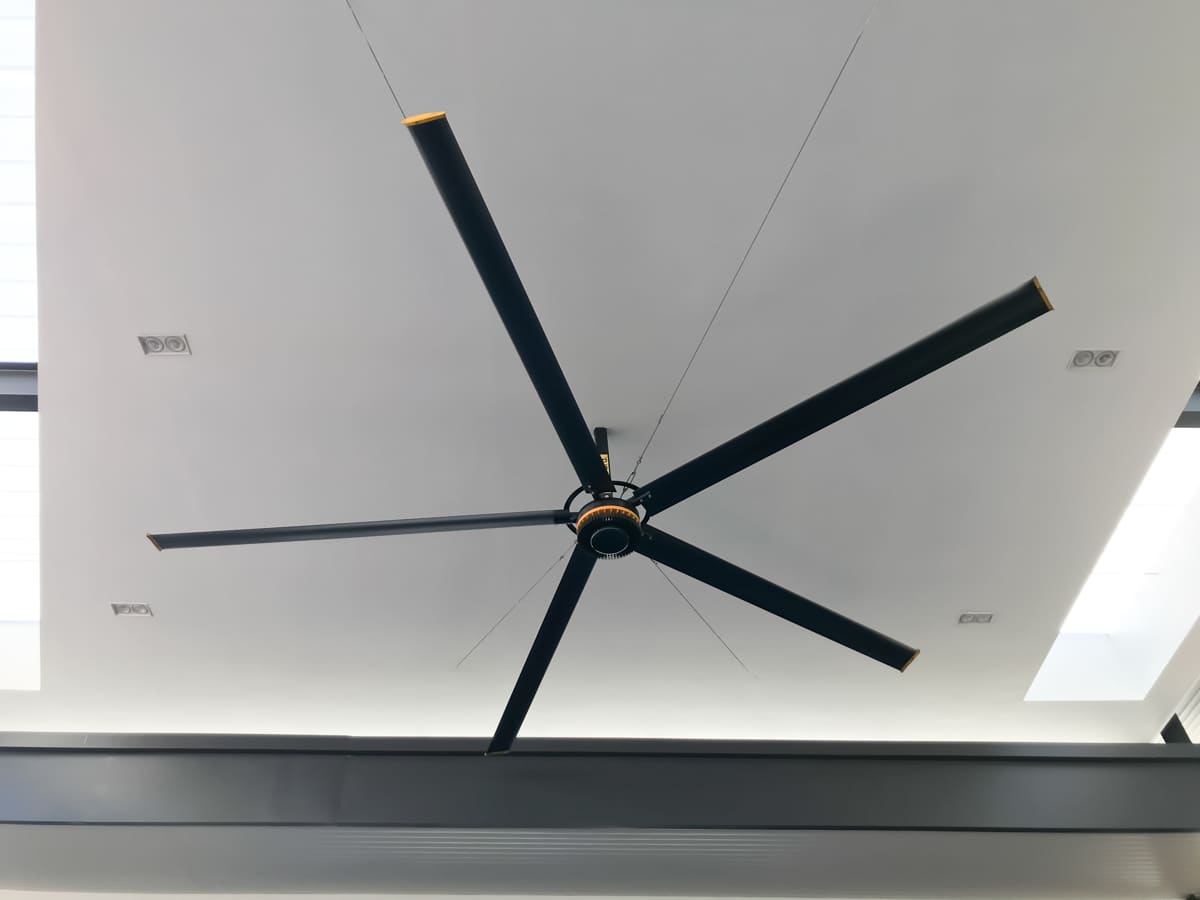
HVLS stands for High Volume, Low Speed. It’s exactly what it sounds like: a large ceiling fan that moves a huge amount of air, but spins slowly to do it. Most HVLS fans range from about 8 feet to 24 feet across, which is many times larger than the ceiling fan you’d find in a home or office.
A regular ceiling fan spins fast and only cools a small area directly underneath it. An exhaust fan pulls air out of a room but doesn’t really move air around inside the space. An air conditioner cools the air itself but is expensive to run across a large factory floor. An HVLS fan does something different: it gently pushes a wide, steady column of air straight down and out across the entire floor, covering a much bigger area with far less spinning speed.
These fans usually have anywhere from 4 to 10 blades, depending on the design, and are mounted high up typically 12 to 40 feet above the floor, which fits well with the tall, open-ceiling sheds common in Bangladeshi factories.
How Does an HVLS Fan Work?
The way an HVLS fan cools a room is actually pretty simple once you picture it. The fan creates a wide column of air that travels straight down from the ceiling. When that column hits the floor, it spreads out in every direction, like water from a tap hitting a sink. This spreading airflow sometimes called a “floor jet” keeps moving outward across the room until it reaches the walls, then rises back up and recirculates. The result is one slow, steady, room-wide breeze instead of a few scattered bursts of air.
This also solves a problem you’ve probably felt yourself: hot air rising and getting trapped near the ceiling while the floor stays stuffy and still. This is called heat stratification, and it’s especially common in factories with high tin-shed roofs, where the hot air just sits up there with nowhere to go. An HVLS fan constantly pulls that trapped hot air down and mixes it with the cooler air near the floor, evening out the temperature throughout the whole building.
There’s one more effect worth mentioning: the moving air helps sweat evaporate off your workers’ skin faster, which makes them feel noticeably cooler even though the air temperature itself hasn’t dropped. That’s the same reason a breeze feels refreshing on a hot day. It doesn’t lower the room’s actual temperature, but it makes the heat far more bearable for anyone working on the floor for eight or more hours a day.
HVLS Fan vs. Traditional Cooling Methods in Bangladeshi Factories
Most factories in Bangladesh currently rely on one of three things: wall-mounted exhaust fans, regular ceiling fans, or split/central AC units. Each comes with its own trade-offs, and it helps to see them side by side.
| HVLS Fan | Exhaust Fan | Standard Ceiling Fan | Split/Central AC | |
| Upfront cost | High (one-time, per fan) | Low | Low | Very high |
| Running cost | Low – runs on a fraction of the power | Low | Low, but you need many units | Very high, especially during long shifts |
| Coverage area | Up to 20,000+ sq ft per fan | Small, local area only | Small, local area only | Limited to sealed/enclosed rooms |
| Maintenance | Low – one motor, infrequent servicing | Moderate – multiple units to maintain | Moderate – many units to maintain | High – filters, gas refills, frequent servicing |
| Best suited for | Large open floors: RMG units, warehouses, dyeing floors | Removing fumes, dust, heat from small zones | Small offices, sample rooms | Small, enclosed, climate-sensitive rooms |
A few things matter a lot for Bangladeshi buyers specifically. Load shedding is still a real concern in many areas, and because an HVLS fan draws far less power than an AC system for the same floor area, it’s much easier to keep running on a generator or limited backup power during outages. Dust, humidity, and lint are also a daily reality on most factory floors, so it’s worth choosing an HVLS fan with an IP-rated motor; these are sealed against dust and moisture and hold up much better over years of use than a standard motor.
For large, open production floors, an HVLS fan typically gives you the best coverage per unit cost. For small, sealed rooms like sample sections or offices, a standard AC or ceiling fan still makes more sense.
Why Are Bangladeshi Industries Switching to HVLS Fans?
Rising electricity costs and unstable power supply
Electricity tariffs for industrial connections in Bangladesh have been climbing steadily over the past few years, and cooling is usually one of the biggest line items on a factory’s power bill. Running dozens of small fans or a large AC system across a big floor adds up fast. A single HVLS fan can cool the same floor area using a fraction of that power, which is why many factory owners see it pay for itself within a couple of years through lower monthly bills alone.
Worker comfort, productivity, and heat-stress compliance
Garment and textile workers often spend long shifts standing or sitting in hot, poorly ventilated spaces, and heat naturally makes people tired, slower, and more prone to mistakes as the day goes on. Better air movement on the floor helps workers stay more comfortable and alert through a full shift. It’s also become a practical expectation rather than a luxury. Many factory managers now treat proper ventilation as a basic part of running a safe, functional workplace, alongside lighting and fire safety.
High-ceiling and large floor-area factory layouts
A lot of factory buildings in Bangladesh, especially tin-shed sheds and warehouse-style structures were built with tall ceilings and wide open floors. That layout happens to be exactly what HVLS fans are designed for. Small fans simply can’t push air far enough to reach every corner of a floor that size, but one or two large HVLS fans mounted at the right height can cover the entire space evenly.
Compliance pressure from international buyers
Bangladesh’s garment sector exports heavily to international retailers, and many of those buyers carry out factory audits that look closely at working conditions, including ventilation and heat management on the production floor. Factories that have upgraded their cooling systems often find it easier to pass these audits and maintain stronger relationships with overseas buyers as a result.
Lower long-term maintenance vs. multiple small fans or AC units
A floor full of ten or twenty small fans means ten or twenty motors that can break down, need rewiring, or stop spinning evenly over time. An HVLS setup usually means just one or two units to maintain instead, which significantly cuts down on servicing visits, replacement parts, and the day-to-day hassle of keeping everything running.
Key Benefits of HVLS Fans for Bangladeshi Industrial Spaces
Lower electricity bills. Because one HVLS fan replaces many smaller fans (or reduces reliance on AC), the total power draw for cooling a large floor drops noticeably; this is consistently the biggest reason factories switch.
Even temperature across the whole floor. Instead of hot spots near the back of the building and a comfortable breeze only near the entrance, the air gets distributed evenly from wall to wall.
Better handling of dust, moisture, and condensation. In textile, dyeing, and food processing units especially, constant air movement helps prevent moisture from settling and reduces the buildup of dust and lint in the air, which is good for both worker health and product quality.
Quieter than a room full of small fans. Because HVLS fans spin slowly, they run far more quietly than a dozen small fans humming away on the walls, which makes the floor a noticeably calmer place to work.
Built to last when sourced and installed properly. A well-imported HVLS fan with a quality motor and proper installation can run reliably for many years with minimal servicing this is one area where working with an experienced supplier really pays off, since the wrong motor or a poor installation job is the most common reason fans underperform or break down early.
Which Industries in Bangladesh Are Best Suited for HVLS Fans?
HVLS fans aren’t limited to one type of factory. They work well anywhere you have a large, open floor and a real heat problem:
- RMG and garment factories – large stitching and cutting floors with high worker density benefit the most from even airflow.
- Textile, dyeing, and finishing units – these floors deal with heat, steam, and moisture all day, and constant air movement helps manage all three.
- Warehouses and logistics hubs – tall ceilings and wide-open layouts are exactly what HVLS fans are built for.
- Pharmaceutical and FMCG manufacturing floors – better air circulation supports more consistent working conditions on the production line.
- Poultry, livestock, and food processing facilities – good ventilation helps manage heat and odor in enclosed processing areas.
- Automobile workshops and showrooms – large open-bay workshops stay noticeably cooler and more comfortable for both staff and customers.
If your facility has a high ceiling and an open floor plan, there’s a good chance an 10FT HVLS fan would make a real difference.
Things to Consider Before Buying an HVLS Fan in Bangladesh
A few practical details matter before you commit to a purchase. First, check your ceiling height and clearance. Most HVLS fans need a minimum mounting height to work properly and safely, so measure your space before choosing a fan size.
Second, look at the motor type. Gearbox motors are generally cheaper upfront but need more regular maintenance, while direct-drive motors cost a bit more initially but run quieter and need far less servicing over time. Also confirm the fan is compatible with local power supply most factories in Bangladesh run on 220–240V, and you’ll need to know whether your facility uses single-phase or three-phase power before ordering.
Third, ask about warranty and after-sales support clearly before you buy. Since these are imported machines, a supplier who can’t service the fan locally or get replacement parts quickly can leave you stuck if something goes wrong months down the line.
Finally, get the sizing right. A fan that’s too small for your floor area won’t give you proper coverage, and one that’s too large is an unnecessary expense. A good supplier should be able to calculate the right blade diameter and number of units based on your floor’s square footage and ceiling height not just sell you whatever they have in stock.
Why Choose Us as Your HVLS Fan Supplier in Bangladesh
We’ve spent years importing and installing Industrial Solutions products for factories across Bangladesh, working directly with manufacturers to bring in motors and blades that are built for the heat, dust, and humidity our climate puts them through. Our team handles the full process sizing the fan to your floor, confirming voltage and power compatibility, installation, and after-sales servicing so you’re not left chasing parts or technicians later.
We’re happy to share details on the specific brands and standards we source from, along with examples of factories we’ve already installed fans in, if that’s helpful for your decision. Our goal is simple: recommend the right fan for your actual space, not the most expensive one we have.
Final Thoughts
More and more factories across Bangladesh are realizing that one well-placed HVLS fan can do what a dozen small fans or an expensive AC system struggle to cool a whole floor evenly, cut electricity costs, and keep running even when the power supply gets shaky. Between rising energy bills, buyer compliance expectations, and the simple need to keep workers comfortable through long shifts, it’s easy to see why the switch is happening industry-wide.
If you’re thinking about upgrading your factory’s cooling setup, we’re happy to take a look at your floor plan and recommend the right fan size and setup for your space, no pressure, just a straightforward assessment. Get in touch for a free quote, or browse our HVLS fan range to see what’s available.
Frequently Asked Questions
What is the price range of HVLS fans in Bangladesh?
Prices vary depending on the fan’s diameter, motor type, and brand, generally ranging from mid-range to higher industrial pricing for larger units. The best way to get an accurate number is to share your floor size and ceiling height with a supplier for a proper quote.
How much electricity does an HVLS fan save compared to AC?
HVLS fans use significantly less power than AC systems for cooling the same floor area, since they move air rather than chill it. Exact savings depend on your floor size, current setup, and usage hours, so it’s worth asking a supplier for a comparison based on your facility.
Can HVLS fans work during load shedding?
Yes, because they draw far less power than AC units, HVLS fans are much easier to keep running on backup generators or limited power during outages, which is a major advantage in areas with frequent load shedding.
What ceiling height is required to install an HVLS fan?
Most HVLS fans need a minimum mounting clearance, often starting around 12 feet, though this depends on the fan’s size and the manufacturer’s specifications. It’s best to measure your ceiling height before choosing a fan model.
Are HVLS fans suitable for humid or dusty factory environments?
Yes, as long as the fan has an IP-rated motor designed to handle dust and moisture. This is especially important for textile, dyeing, and food processing floors where humidity and airborne particles are a daily reality.
How long does installation take?
Installation time depends on the number of fans, ceiling structure, and electrical setup, but a single fan is typically installed within a day by an experienced team. Larger multi-fan projects may take a few days.