

How Much Electricity Can an HVLS Ceiling Fan Save in Bangladesh?

Running a large factory floor or garment warehouse in Bangladesh has always been an uphill battle against intense tropical heat. But with the recent June 2026 BERC tariff hikes pushing industrial power rates up by nearly 17%, managing a facility’s cooling bill has become a direct threat to profit margins. When temperatures on a busy Ready-Made Garment (RMG) weaving floor spike, worker fatigue sets in, and productivity drops drastically. For years, the only solution was to mount dozens of high-velocity floor fans or invest in massive, budget-breaking industrial air conditioning.
Now, many factory owners are realizing that traditional ventilation systems are simply bleeding money. True industrial energy efficiency requires a smarter approach. High-Volume Low-Speed (HVLS) fans present a proven cost-cutting strategy. Instead of consuming heavy electricity to fight the heat, these massive ceiling fans use minimal power to completely change the indoor climate of local manufacturing hubs. To see how this technology works from the ground up, read our comprehensive breakdown on Why More Bangladeshi Industries Are Choosing HVLS Ceiling Fans
The Industrial Cooling Challenge in Bangladesh’s Climate
Maintaining a safe, productive indoor environment in Bangladesh is an engineering nightmare due to the local climate. During the long summer months, outdoor temperatures routinely climb past 35°C. When you combine this heat with relative humidity levels that frequently cross 80%, the air becomes thick, heavy, and incredibly difficult to cool. Inside a large facility like a bustling Ready-Made Garment (RMG) weaving floor or a packed logistics warehouse the situation is even worse. Machinery, intensive lighting, and hundreds of workers constantly generate their own heat, creating stagnant, suffocating heat pockets that trap hot air in large-scale layouts.
Traditional System Pitfalls :
- Small Pedestal Fan – Just chop up and recirculate the trapped hot air.
- Exhaust Systems – Pull air out but fail to lower the perceived floor temperature.
- Industrial Chillers – Effective, but push power bills past sustainable limits.
When indoor conditions reach these extremes, it takes a massive toll on worker health and factory floor productivity. Heat stress causes exhaustion, slows down manual dexterity, and increases manufacturing errors.
To combat this, factories have traditionally relied on installing dozens of high-velocity pedestal fans or running heavy industrial air conditioning. However, under the updated Bangladesh Power Development Board (BPDB) industrial tariffs, these methods are financially unsustainable. With flat-rate industrial tariffs sitting at 12.73 Taka per unit (kWh), running rows of power-hungry smaller fans or massive chillers around the clock drains factory profits faster than ever. Facility managers can no longer afford to throw inefficient electricity at a structural climate problem.
What is an HVLS Fan and How Does It Work?
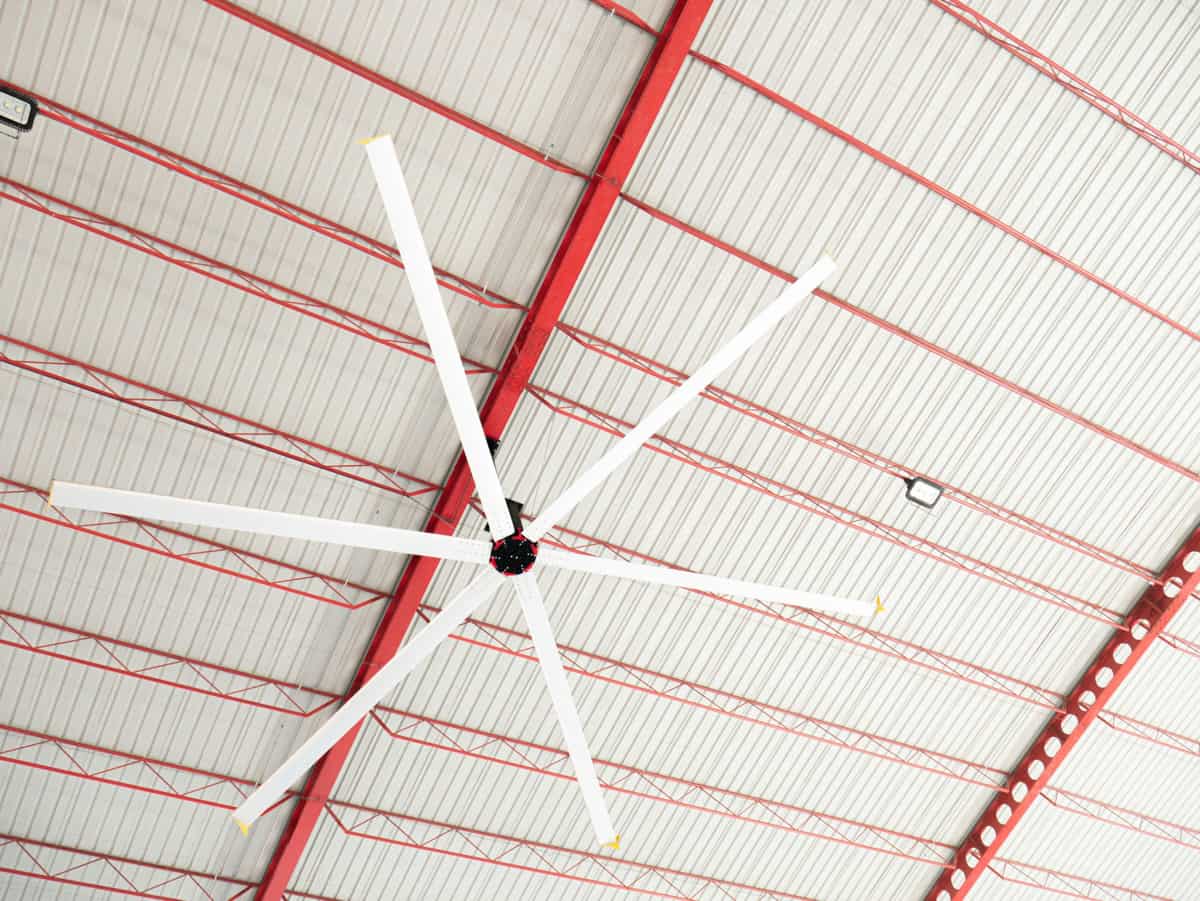
An HVLS (High-Volume Low-Speed) fan is exactly what its name suggests: a massive ceiling fan designed to move a huge volume of air at a very slow rotational speed. Instead of using small, fast blades that create localized, noisy pockets of air, an HVLS fan relies on advanced aerodynamics and specially engineered airfoils. These large blades typically span anywhere from 12 to 24 feet in diameter.
The core concept relies on physics rather than sheer motor speed. As the massive blades rotate slowly, they push a giant column of air downward toward the floor. When this column hits the ground, it spreads out smoothly in all directions, creating a continuous, gentle breeze across an enormous footprint.
Instead of the harsh, disruptive buffeting of traditional high-velocity wall fans, an HVLS fan mimics a natural outdoor breeze. This consistent movement of air breaks up humid boundary layers on the skin, enhancing the body’s natural evaporative cooling effect. For workers on a crowded production floor, this continuous airflow can make the indoor environment feel up to 5°C cooler without ever dropping the actual room temperature.
Calculating the Energy Consumption: HVLS vs. Traditional Cooling Options
To truly understand how much electricity you can save, we need to look at the hard numbers. Let’s compare what it takes to cool a standard 10,000-square-foot factory floor using traditional fans versus a modern HVLS system.
Power Demand of High-Velocity Industrial Pedestal/Wall Fans
To cover a large 10,000-square-foot production area, a factory typically needs to install and run anywhere from 15 to 20 standard industrial pedestal or wall-mounted fans. Each of these high-velocity fans draws about 250 watts of electricity to keep the air moving at high speeds. When you multiply that power draw across 20 individual units, the numbers add up quickly. Your facility ends up pulling a cumulative total of 3.5 kW to 5.0 kW of electricity every single hour just to provide localized, choppy airflow to your workers.
Power Demand of a Single Industrial HVLS Fan
Now let’s look at the alternative. Because of their massive blade span and aerodynamic engineering HVLS fan doesn’t need to fight against the air; it glides through it. To cover that exact same 10,000-square-foot floor space, you only need a single 24-foot industrial HVLS fan. Driven by a highly efficient motor, this single large fan requires just 1.5 kW of electricity per hour to run at full capacity.
The Energy Differential
The gap between these two setups reveals a massive difference in energy consumption. By replacing 20 small, struggling wall fans with just one efficient HVLS ceiling fan, your power demand drops instantly from an average of 4.5 kW per hour down to just 1.5 kW per hour.
| Cooling Setup (10,000 sq. ft.) | Total Power Demand (kW/hr) | Continuous Energy Used |
| 20 Industrial Pedestal Fans | 4.5 kW | High consumption, choppy air |
| 1 Industrial HVLS Fan | 1.5 kW | 66% power reduction, uniform breeze |
That is a direct, measurable savings of 3.0 kW every single hour your facility operates. Instead of wasting energy running dozens of noisy, individual motors, a single system distributes a massive column of air smoothly and evenly across the entire floor, cutting your ventilation energy consumption by over 66% right out of the gate.
How Much Can a Bangladeshi Factory Save Monthly?
To see the financial impact of making this switch, let’s look at a practical, data-backed math simulation based on real local operating conditions. For this calculation, we will use the Bangladesh Energy Regulatory Commission (BERC) flat industrial tariff rate of 12.73 Taka per kilowatt-hour (kWh).
The Savings Breakdown Matrix
Most manufacturing units in hubs like Gazipur, Narayanganj, or Chattogram operate on intensive schedules. The calculation below shows the expected financial savings across a 10,000-square-foot floor when switching from 20 traditional fans to a single HVLS fan.
- Hourly Electricity Saved: 3.0 kW (derived from a drop from 4.5 kW down to 1.5 kW)
- Hourly Financial Savings:3.0 kW * 12.73 Taka =38.19Taka/hour
- The total financial return scales distinctly depending on whether your facility operates on a standard single-shift system or a continuous around-the-clock schedule:
| Timeline | 12-Hour Daily Shift (Single-Shift Factory) | 24-Hour Continuous Operation (RMG/Spinning Mills) |
| Daily Savings | 458.28 Taka | 916.56 Taka |
| Monthly Savings (26 Days) | 11,915 Taka | 23,831 Taka |
| Annual Savings | 142,983 Taka | 285,964 Taka |
Note: Actual savings will naturally vary slightly depending on your regional distribution company (such as DESCO, DPDC, or BREB), your specific contractual demand charges, and any seasonal tariff adjustments.
Estimated Payback Period (ROI)
While upgrading your ceiling ventilation requires an initial capital investment, the system actively pays for itself. For an average facility in Bangladesh, the direct drop in monthly utility bills offsets the cost of the equipment and installation within 12 to 18 months.
Because high-quality industrial HVLS fans are built for long-term durability, they continue to provide essentially free, highly efficient cooling for years after that initial payback point is reached, directly protecting your bottom line against future energy cost increases.
The Synergy: Running HVLS Alongside Industrial HVAC Systems
In certain specialized environments such as pharmaceutical packaging facilities, electronics assembly plants, or premium garment finishing zones relying purely on ventilation isn’t an option. These facilities must use industrial air conditioning (HVAC) systems to control ambient conditions. However, running massive commercial chillers or central AC units in a hot, humid climate like Bangladesh can quickly cause power bills to skyrocket.
This is where installing HVLS fans alongside your existing air conditioning system creates a powerful, money-saving partnership.
[HVAC + HVLS Synergy]
AC Temperature Raised by 2°C to 3°C + Constant Gentle HVLS Airflow = Same Perceived Cooling + 10% to 15% Power Savings
By nature, cold air drops while hot air rises, often causing heavy air conditioning systems to create cold pockets near the floor while leaving the rest of the room unevenly cooled. Because an HVLS fan gently destratifies (mixes) the air, it blends these temperature layers, distributing conditioned air uniformly across the entire production floor.
This consistent airflow allows facility managers to safely raise the thermostat setting on their commercial chillers by 2°C to 3°C without any loss of comfort for the workers on the ground. The financial impact of this small adjustment is massive: in industrial engineering, every single degree you raise your AC thermostat reduces the system’s energy consumption by roughly 3% to 5%. By pairing the two systems, you significantly lower the workload on your most expensive cooling equipment, extending its lifespan while cutting overall HVAC operational costs by 10% to 15%.
Key Factors That Influence Your Actual Savings in Bangladesh
While the energy math for HVLS fans is highly compelling, the exact savings your facility will achieve aren’t one-size-fits-all. Because every factory floor in Bangladesh is built differently, several real-world structural factors will directly influence your final monthly electricity bill.
- Ceiling Height and Building Architecture: To work effectively, an HVLS fan needs room to breathe. The system functions by pushing a massive column of air down to the floor, which requires a minimum factory ceiling height clearance of 15 feet. If your ceiling is too low, the air column cannot develop properly; if it is an exceptionally high-pitched roof, the fan may require customized extension drop rods to position the airfoils at the sweet spot for maximum floor coverage.
- Roof Insulation: Many industrial warehouses and garment units across areas like Savar or Tongi use uninsulated corrugated metal-sheet roofing. During midday, these uninsulated metal sheets turn into massive heat radiators, driving internal temperatures up. If your roof lacks thermal insulation, the fan will still provide an excellent breeze, but it has to fight a much higher heat load. Combining insulation with HVLS fans yields the absolute highest energy savings.
- Proper Placement and Sizing: You cannot simply hang a large fan anywhere and expect maximum results. A professional site assessment is critical. An expert supplier will analyze your floor layout—mapping out where heavy machinery sits, where concrete pillars are located, and where your workers are stationed—to avoid obstacles and prevent dead zones where air stands still. Proper positioning ensures every corner of your facility receives continuous, cost-saving airflow.
Conclusion & Actionable Next Steps
With industrial energy rates on a steady upward trajectory in Bangladesh, managing everyday operating costs has become a critical survival metric for factory owners. Upgrading your facility layout with High-Volume Low-Speed ceiling fans offers a direct, highly effective way to ease the strain on your monthly utility bills. The operational benefits extend far beyond a standard 66% drop in ventilation power consumption; you also gain a safer, significantly more comfortable workplace that naturally keeps worker productivity stable during our most humid summer months.
Rather than viewing cooling as a fixed, unavoidable overhead cost, forward-thinking facility managers are shifting focus from initial setup costs to long-term operational savings. To find out exactly how much electricity your specific facility can save, you can take a practical next step: request a customized energy audit and a complete 3D airflow simulation tailored directly to your floor space.
Here are 5 frequently asked questions (FAQs) designed to match the exact tone, style, and context of your blog post. They naturally reinforce the core message of the article while addressing common real-world concerns a factory owner would have.
Frequently Asked Questions
Can one HVLS ceiling fan really replace 15 to 20 traditional pedestal fans?
Yes, easily. Traditional fans use small, high-speed blades that only blow air in a tight, narrow path, forcing you to install dozens of units to cover a large floor. A single 24-foot HVLS fan relies on aerodynamic airfoils to push a massive column of air straight down to the floor. Once that air hits the ground, it glides outward in all directions, smoothly creating a uniform breeze across an entire 10,000-square-foot footprint without any dead zones.
What is the minimum ceiling height required to install an industrial HVLS fan?
Your facility needs a minimum ceiling clearance of 15 feet for an HVLS fan to operate efficiently. Because these fans move a giant volume of air, they require enough overhead space to draw air in from above before pushing it downward. If your ceiling is lower than 15 feet, the air column cannot develop properly, which drastically reduces the cooling effect and defeats the purpose of the system.
Our factory roof is made of uninsulated corrugated metal sheets. Will an HVLS fan still work?
It will definitely still work and provide a massive cooling breeze for your workers, but it will have to fight a much higher heat load. Uninsulated metal sheets act like giant radiators at midday, constantly pouring heat onto the production floor. While the fan will instantly improve comfort through its natural evaporative breeze, combining proper roof insulation with an HVLS system will always yield the absolute highest energy savings for your facility.
How does an HVLS fan save money if our factory already runs central air conditioning?
Instead of competing with your HVAC system, an HVLS fan acts as a perfect partner. Air conditioning naturally creates cold pockets near the floor while leaving hot air trapped higher up. An HVLS fan gently mixes these air layers, distributing the cool air perfectly across the entire room. This balanced temperature allows you to safely raise your central AC thermostat by 2°C to 3°C without anyone noticing a difference. Because every degree you raise a commercial chiller cuts its power usage by 3% to 5%, your overall HVAC electricity bill drops by 10% to 15%.
What is the typical lifespan and maintenance routine for an industrial HVLS fan?
High-quality industrial HVLS fans are built to be highly durable “set-and-forget” systems for heavy manufacturing environments. Most models require virtually zero day-to-day maintenance, as they feature sealed gearboxes or direct-drive motors designed to keep out dust, lint, and factory debris. Because they rotate at a very low speed, there is very little mechanical wear and tear, allowing them to operate reliably for decades—well beyond their initial 12-to-18-month financial payback period.